

Keep the AI coding capabilities you love. Gain more model freedom, cost control, security and enterprise-grade AI capabilities.

Let’s get one thing straight: Cursor is a good AI coding tool.
It helped make agentic coding mainstream. Developers use it to plan, write, debug, refactor, and ship software faster.
But here’s the question: What if you could keep the AI coding capabilities you depend on, gain more control over your models and infrastructure, and stop letting your recently acquired coding tool dictate your AI strategy?
That’s the case for Kilo by Anaconda.
And if you’re already paying for Cursor Enterprise, here’s the kicker: we’ll cover your Kilo Enterprise subscription for up to 12 months. More on that below.
1. Model freedom that goes beyond a dropdown
Cursor supports multiple models. So does Kilo.
The difference is how much control you have over the models, providers, and infrastructure behind them.
With Kilo, you can access 500+ models, bring your own API keys, connect to supported providers directly, or run compatible open-weight models locally such as Ollama or LM Studio. You can even build and run Local AI on NVIDIA RTX Spark with Windows on Arm on numerous devices.
Want GPT for one task, Claude for another, and a local model for something sensitive? Go for it.
Want to use Amazon Bedrock or your existing inference contracts? Go for it.
Your code. Your models. Your call.
2. More control over what your agents cost
Agentic coding is powerful. It’s also remarkably good at burning through tokens.
One prompt becomes ten tool calls. Ten tool calls become a twenty-minute agent session. Suddenly, you’re wondering what that little adventure cost.
Unlike Cursor, Kilo gives you transparent token pricing, team budgeting, session-level cost visibility, bring-your-own-key options, and automatic model routing to help optimize cost and performance.
Kilo Gateway offers zero markup on model token prices, with separately billed services and applicable fees handled independently.
For developers, that means easier to choose the best low cost model and more visibility into what you’re spending. For development managers, it means better control over AI costs across teams.
More useful work per dollar. Fewer overruns and surprises.
3. More than a coding agent with the power of the Anaconda ecosystem
Kilo is part of Anaconda, bringing AI coding together with the trusted foundation behind millions of Python developers, AI models and agents and platforms.
That opens up capabilities beyond code generation:
Trusted AI Artifacts: Access Anaconda’s vetted packages, trusted environments, curated models and MCPs.
AI Data Science: Work with Jupyter notebooks, conda environments, and AI agents in Kilo Desktop.
AI agent safety: Add optional Enkrypt AI by Anaconda security testing and runtime protection capabilities to help test and control agent behavior in dev, pre-prod and production.
Some capabilities require additional Anaconda products or integrations, but the opportunity is bigger than choosing another coding assistant.
Build with the tools you want AND get the control your organization needs.
4. But what do you lose by switching?
For most developers, you’ll never notice.
Kilo supports the core workflows you expect: autonomous coding agents, planning, multi-file editing, debugging, testing, cloud agents, MCP integrations, and Git workflows.
You can work in VS Code, JetBrains, the CLI, Kilo Desktop, or agents in the cloud. You can even manage agents from your phone or Slack.
There are differences in how individual features work, but you don’t have to give up modern agentic development to make the switch.
Think you’ll miss something? Let’s compare.
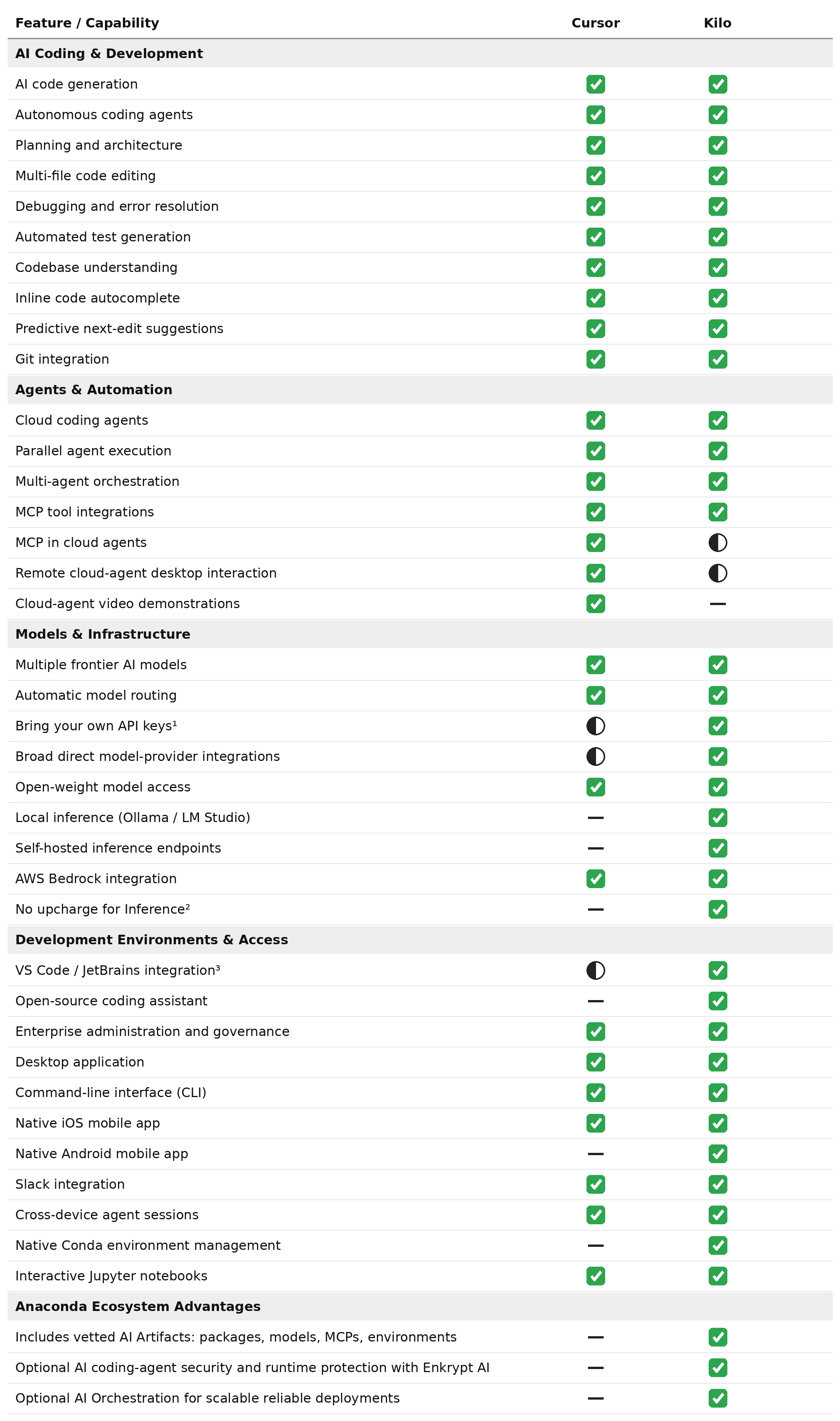
Footnotes (Cursor details as of November 2026):
¹ Bring your own API keys: In Cursor, your own API keys work only with chat models. Tab completion keeps using Cursor’s built-in models, and every request is routed through Cursor’s servers. On Teams and Enterprise plans, the Cursor Token Rate still applies to requests made with your own key. Source
² No upcharge for inference: Cursor charges Teams and Enterprise customers a Cursor Token Rate of $0.25 per million tokens on eligible third-party model requests. It applies to input, output and cached tokens, including requests made with your own key. Individual plans and Cursor’s own models, including Grok and Composer, don’t pay it. Source
³ VS Code / JetBrains integration: Cursor is a standalone editor, not a VS Code extension. In JetBrains IDEs, Cursor’s agent runs through the Agent Client Protocol (ACP) inside JetBrains’ AI Assistant plugin, and it requires a paid Cursor plan. Source
The core capabilities are there. And now you can see where Kilo gives you more.
5. Still paying for Cursor? We’ll cover Kilo Enterprise for up to a year.
Now for the fun part.
If your organization has an eligible paid Cursor Enterprise contract, you can apply for our Cursor Exodus promotion.
Here’s the deal:
$0 Kilo Enterprise subscription fees for the remaining term of your eligible Cursor contract, up to 12 months.
We’ll match your Cursor Enterprise seat count 1:1, giving your team access to Kilo Enterprise while your existing Cursor agreement runs its course.
That includes enterprise capabilities such as centralized administration, model policies, SSO, SCIM, audit logs, and usage visibility.
AI inference and separately billed services are excluded from the subscription promotion. Eligibility and contract verification apply.
Applications close November 30, 2026.
Claim your Cursor Exodus offer
Keep building while Gaining Freedom and Control
Switching AI coding tools shouldn’t mean starting over.
Kilo gives you the core agentic coding capabilities you expect, plus greater flexibility over models, providers, infrastructure, and costs. And with Anaconda behind it, you have a path to trusted AI development and enterprise governance as your team scales.
Cursor helped move AI coding forward.
Kilo gives you more control over where it goes next.
Ready to make the move?
Join the Cursor Exodus. Get up to 12 months of Kilo Enterprise.
Offer subject to eligibility, verification, and approval. Inference and other separately billed services are excluded. Apply by November 30, 2026.
