

The wait is over. Anthropic’s story about the biggest, best SOTA model on the planet is no longer just a fairytale. Today, Anthropic announced Claude Fable 5, and it’s already live in Kilo.
If you’ve been following the rumors, you know that Anthropic has been developing some incredible capabilities behind closed doors. Now that it’s here, Fable 5 isn’t just an iterative update. It’s a paradigm shift in how AI models can operate independently across both knowledge work and agentic engineering.
Here’s everything you need to know about Fable 5, the journey to get here, and how to harness its power in Kilo.
The Road to Fable: Three Steps from Opus 4.7
To appreciate just how massive Fable 5 is, we have to look back at the evolutionary stepping stones taken since the last major Opus release.
Anthropic released Opus 4.7 less than two months ago. Maybe it hasn’t been a straight line to Fable 5, but now it feels like a deliberate three-step journey.
1. Optimizing for Speed (Opus Fast)
Our first major pivot after the core Opus release was Opus Fast. The goal was simple: reduce latency to near-zero for real-time applications. The results were objectively impressive, enabling voice-to-voice and rapid-response architectures we hadn’t seen before. However, the brute-force compute required to achieve those speeds made it insanely expensive to run at scale. Fast modes for Opus 4.6 and 4.7 cost $30 per million input and $150 (!) per million output. For context, that’s 6x typical Opus model pricing and ~40x more expensive than a top open model like Kimi K2.6.
But with Claude Opus 4.8 Fast, Anthropic lowered fast-mode pricing and seemed to find the upper limits for what power users were willing to pay. Fast mode for Opus 4.8 costs the same as Fable 5: $10 per million input tokens, $50 per million output tokens.
2. Optimizing for Efficiency (Opus 4.8)
Recognizing the cost barriers of Opus Fast, the focus shifted to optimization. With Opus 4.8, we saw a masterclass in model distillation and architectural efficiency. For the exact same complex reasoning tasks, Opus 4.8 often delivers a massive 20% reduction in cost compared with Opus 4.7.
There were a lot of technical improvements behind the scenes here, including smarter adaptive effort, better recall, and the ability to carry state more reliably across long sessions. The move from Opus 4.7 to 4.8 felt like the model itself was actually becoming smarter. And it proved that top-tier intelligence doesn’t require an infinite budget.
3. Breaking the Mold (Fable 5)
If Opus 4.8 perfected the existing formula, Fable 5 breaks the mold entirely. It is mind-blowingly good, but what truly separates it is its ability to act independently. Fable 5 isn’t just a chatbot; it’s an agent. You can give it a high-level objective, and it will self-prompt, browse, write code, test its own outputs, and navigate an operating system until the goal is met.
As Kilo continues to experiment with model routing and making it easier for developers to keep costs in check, we’re guessing that heavyweights like Fable 5 will be a part of the wider mix of models developers use. But not the only models. You don’t always need a VP on every call, working every project.
In fact, that’s exactly the conclusion Fable 5 came to when I ran a series of prompts to convince it to share its view on how the LLM landscape looks right now, with its own release into the wild.
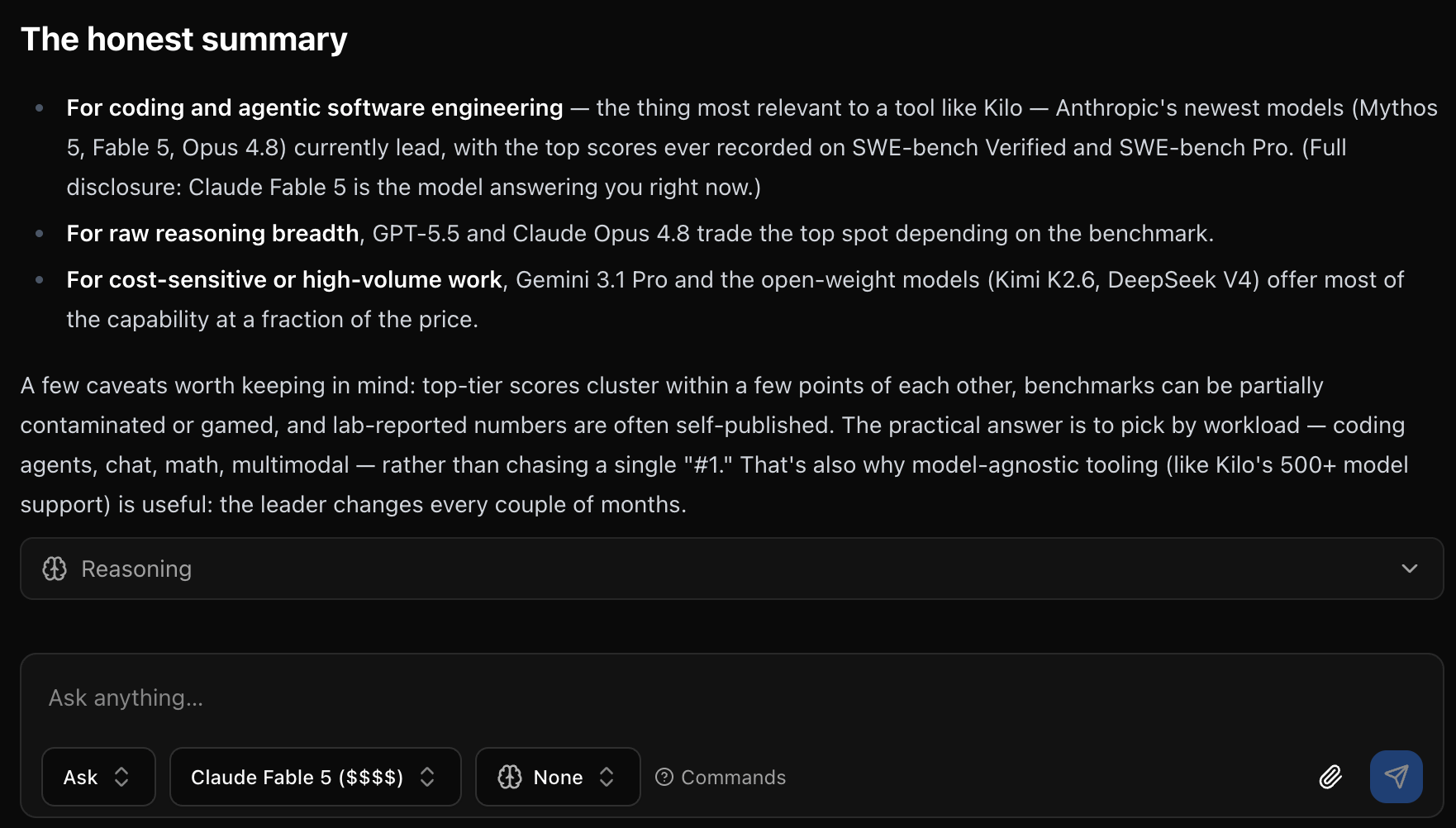
Even Claude Fable 5 didn’t say “use Fable all the time”. In fact, it suggested using a blend of Fable, Opus and GPT-5.5 (OpenAI’s leading frontier model) for complex tasks, alongside Google’s Gemini models open-weight models like Kimi and DeepSeek, which have been leaders on the Kilo Leaderboard for many months now.
Why Fable 5 Over Mythos 5?
Earlier today, Anthropic officially announced their dual-model breakthrough: Fable 5 and Mythos 5. While both models achieved staggering benchmark scores, you might be wondering why Fable is the model being pushed to a wider audience, while Mythos remains highly restricted. The answer comes down to safety, alignment, and agentic reliability. Mythos 5 is an unconstrained research powerhouse, but Fable 5 was explicitly designed to operate safely in the wild.
The arc runs from a deliberately restricted preview to a safeguarded public launch over about two months. Anthropic released Claude Mythos Preview in April 2026 through Project Glasswing, limiting access to a small group of cyber defenders and critical software infrastructure providers because Mythos-class models had crossed a capability threshold presenting significant risks — the model proved unusually good at finding vulnerabilities across every major operating system and browser despite not being designed for cybersecurity. Last week, access expanded to hundreds of organizations across 15 countries, and today the company launched Claude Fable 5, the first generally available Mythos-class model.
The key change enabling public release is the safeguard layer: queries in certain high-risk areas instead receive a response from Opus 4.8, with the classifiers tuned conservatively enough to trigger in under 5% of sessions, and Anthropic ran an external bug bounty with over 1,000 hours of testing in which no universal jailbreak was found.
Alongside Fable, Claude Mythos 5 — the same underlying model with safeguards lifted in some areas — ships to Project Glasswing participants as an upgrade to Mythos Preview. In other words, anybody in the Glasswing program now has access to the post-preview Mythos. The rest of us get Fable 5.
It’s worth revisiting their findings during testing of Mythos Preview, to give a sense for the remarkable capabilities at play here:
Cloudflare ran Mythos Preview against more than fifty of its own repositories, and were stunned by its thoroughness. Their report on Mythos Preview details how the model builds working proof-of-concept exploits — writing code to trigger a bug, compiling and running it in a scratch environment, and revising on failure — and constructs exploit chains that string together several low-severity primitives into something serious. It also covers the noise/triage problem and their harness design — narrow scoping, specialized parallel agents, and adversarial review where separate agents independently verify findings.
Cloudflare’s advice to narrow scope is highly applicable to Fable 5 too, as it needs explicit instructions to keep it under control. This is how they put it:
Telling the model “Find vulnerabilities in this repository” makes it wander. Telling it “Look for command injection in this specific function, with this trust boundary above it, here’s the architecture document and here’s prior coverage of this area” makes it do something much closer to what a researcher would actually do.
XBOW, an autonomous offensive-security firm, found Mythos Preview substantially better than prior models at finding vulnerability candidates, especially with source access, with strong results in native-code analysis and reverse engineering — including identifying true positives in V8 sandbox work where previous approaches produced no successful true positives.
XBOW seemed in awe of the model’s technical prowess:
[The model] communicates with unusual technical precision, reasons well about code, and shows strong promise in complex domains such as native-code analysis and reverse engineering.
Reverse engineering is exciting, until it’s used for nefarious purposes.
So the evolution is less about the model itself — after all, Fable 5 and Mythos 5 share the same weights — and more about Anthropic building safety infrastructure robust enough to take Mythos-level capability from a trusted-access program to general availability.
Benchmarks and Pricing
Fable 5 is twice the cost of standard Opus 4.8. In other words, even in the current frontier model landscape, it’s expensive.
Claude Fable 5: $10 per million input tokens, $50 per million output tokens.
Claude Opus 4.8: $5 per million input tokens, $25 per million output tokens.
Prompt Caching: Both models support up to a 90% discount for cached inputs.
We’re finding that Fable is really good at one-shotting and staying within guidelines, which in theory should help keep costs relatively low, but this is not a cheap model. Nor is it intended to be.
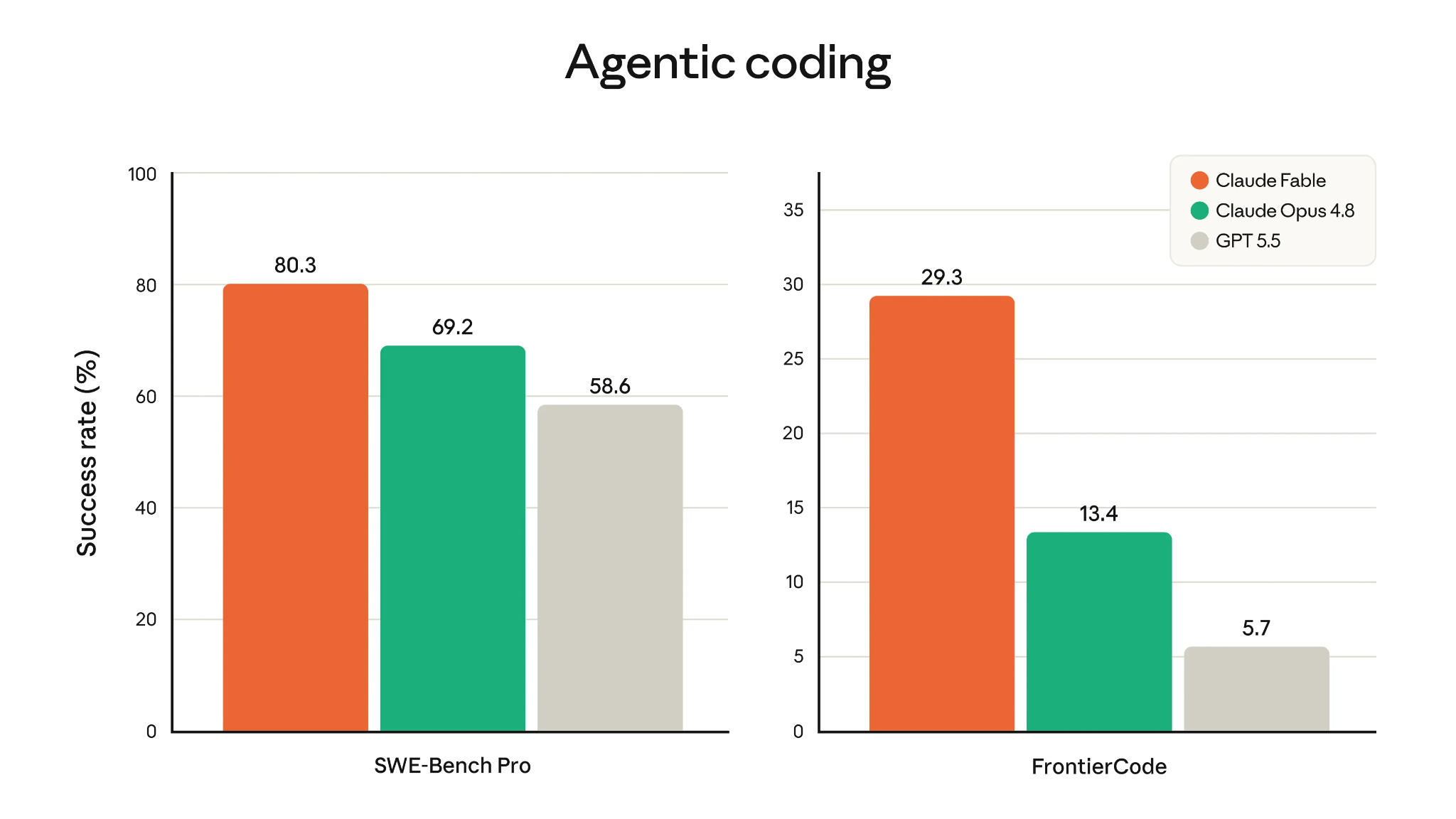
Fable 5 scores an incredible 80.3% on SWE-bench Pro, demonstrating near-human capacity for resolving complex, real-world GitHub issues. Even more mind-blowing is its 85% on OS-World Verified for computer use—coming incredibly close to Mythos Preview’s massive 85.4%.
The benchmarks here actually match reality, with Fable 5 seemingly able to create entire apps based on just a screenshot — something previous models have claimed to do, but they always required extra prompting to reach functionality as soon as the challenges became serious ones.

Fable 5 is the definitive choice for developers building autonomous, real-world applications. And those scores are plenty good enough. Once you give Fable a spin for a big project (assuming you have the budget to support it), you will likely no longer be longing for Mythos.
Domain Usage, Safeguards, and Data Retention Policies
A couple of things to note.
First off, in order to release Fable safely, Anthropic has built in safeguards that, in practice, limit Fable’s ability to engage in cybersecurity and biology queries. If a prompt triggers these domains, the system will instead reroute to Opus 4.8 automatically to deliver a safe response. Learn more about the safeguards.
In addition, Fable will not support Zero Data Retention (ZDR). Please read that again: it will not support ZDR.
Customer content is retained for 30 days to detect and prevent serious harm, then automatically deleted “except in very rare situations”. Data retention comes accompanied with rigorous privacy and security controls. Prompt and data retention might make this new model a no-go for many enterprises, but we understand why Anthropic made the move to ensure security. Learn more about data retention for Claude Fable 5.
To make the most out of Anthropic models, make sure to update your Settings in Kilo to allow (or restrict) access to models that retain customer data.
Ready to Give It a Spin?
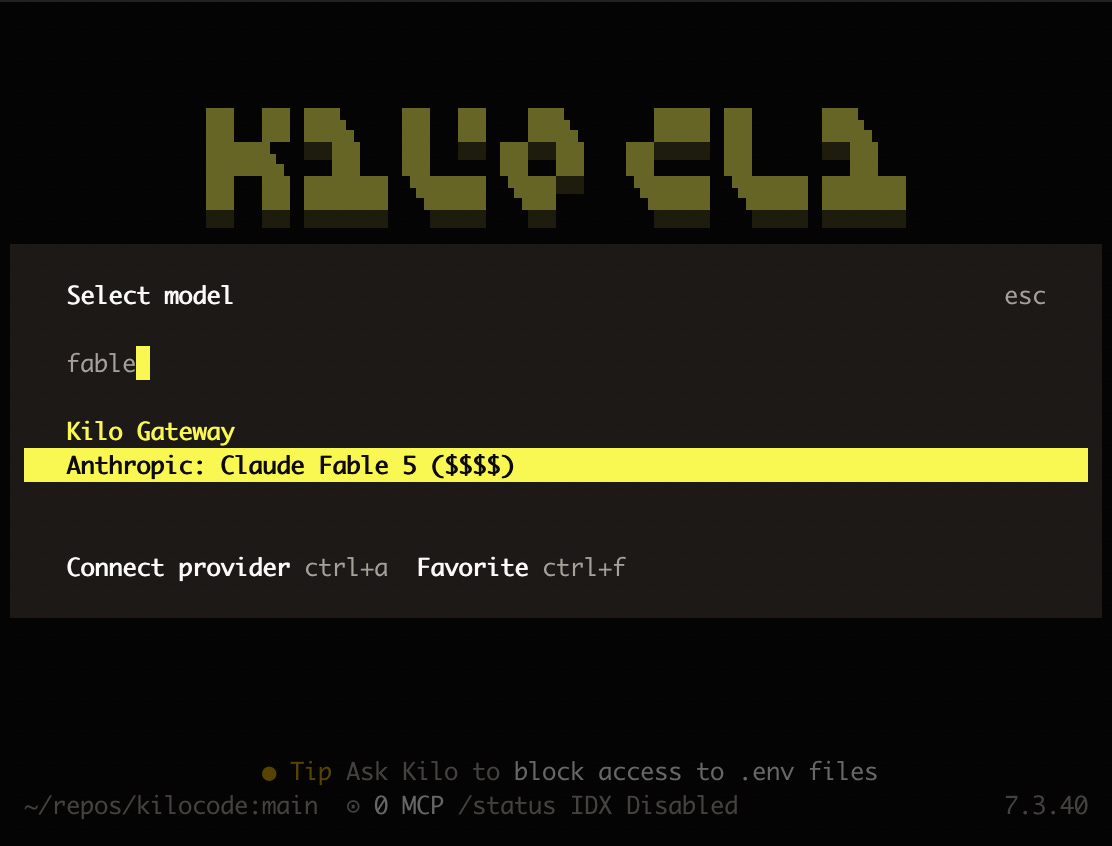
Claude Fable 5 is live right now in the Kilo playground and API. Because of its highly autonomous nature, we highly recommend being crystal clear with your goals and setting firm cost thresholds before turning it loose on a complex task.
At Kilo, our mission has always been to make model freedom accessible to everybody. We recommend using Fable 5 as the heavy-lifter in a broader model mix — use smaller models for basic routing, and tag Fable 5 in when you need independent execution.
One more thing: To celebrate the launch, recent Opus and Sonnet models are currently 20% off in Kilo. There has never been a better time to optimize your AI stack.
Log in to Kilo Code today and let Fable 5 show you what the future looks like in the Kilo CLI or one of our IDE extensions. Happy building!
Not just 2 not next week mush baltrr Nagia baltrr toaby form have girty not