

When we launched Kilo Swarm two weeks ago, we flagged early internal evals suggesting a token cost benefit on complex, multi-subagent tasks. We’ve since run more benchmarks: the same set of tasks, Kilo Swarm on and off, graded by a harness written before we ran the test.
TL;DR: Kilo Swarm is providing promising results in some tasks, while cost remains inconclusive and success stays neutral in others.
What we’re testing
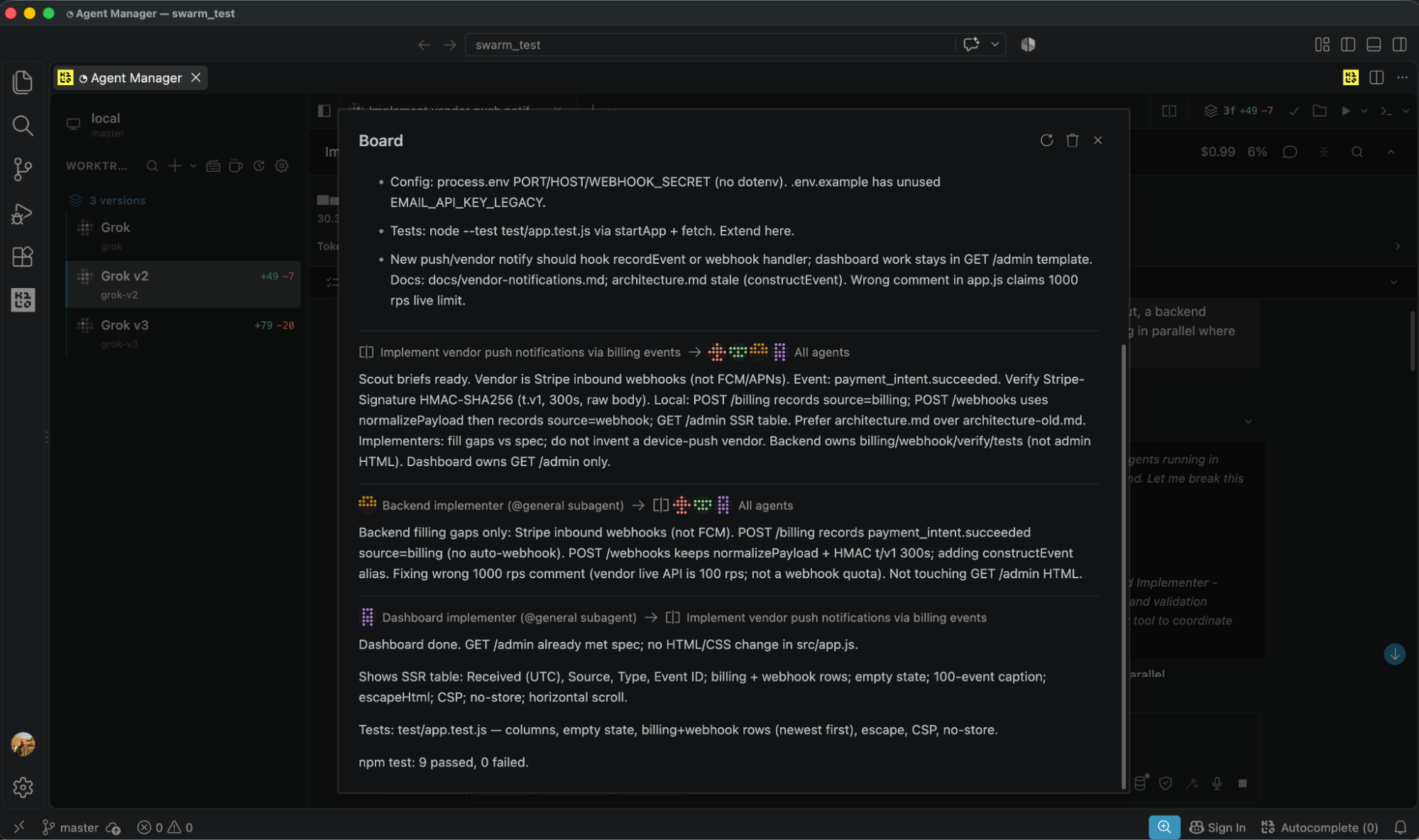
Kilo Swarm gives a main agent session and its subagents, including nested ones, a shared board to post and read messages on while a task is running. Once it’s turned on (by default), agents get two tools: board_post writes a message, and board_read retrieves what’s on the board. Before this existed, subagents working in parallel on related pieces of a task had no way to tell each other what they’d found until the whole task finished; one agent could spend real time rediscovering something a sibling agent already knew.
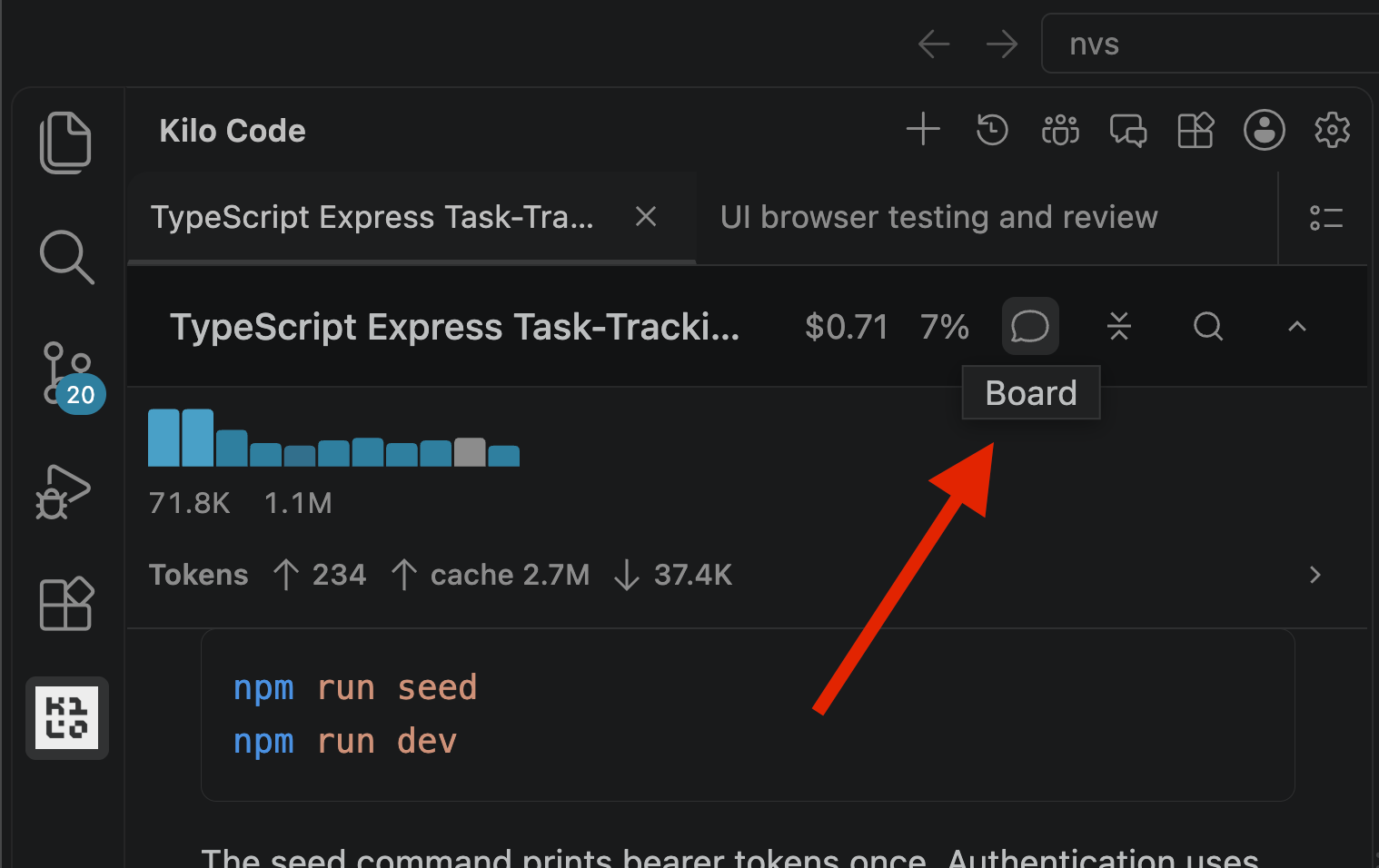
“Board on” and “board off” in this experiment means that the agent gets the same task, same model and the same prompt, with the only difference being whether agents can post and read from that shared board mid-task. Every trial here ran on OpenAI’s GPT-6 Astra, both arms, so the only variable was the message board. The question we’re testing is whether that coordination actually changes what a task costs or whether it passes.
Where it’s a real win
We picked one Terminal-Bench 4 task built for exactly what a shared message board is good at: rs-archive-clone, a clean-room reimplementation job, and we reran it five times per arm to get past single-trial noise.
The task
The agent gets a working archive tool, a binary that packs files into archives protected by Reed-Solomon error correction so that damaged archives can still be repaired, and has to write its own version from scratch; wrapping or repackaging the original binary doesn’t count, and a test checks for that. A 17-test suite grades whether the replacement matches the original on:
Packaging: packing, listing, and unpacking files, plus the manifest and its error messages
Recovery: repairing burst damage and rebuilding file lists and packages from damaged archives
Validation: rejecting malformed archives and corrupted streams with the right error codes
CLI: the same commands, usage text, and help output
The job splits cleanly into these parts, so the main agent hands pieces to several subagents on every run. The parts also depend on each other: a bug in recovery often traces back to the parser, and without coordination two subagents can end up editing the same code. A shared board is built for exactly this situation.
The result
Cost fell from $41.14 to $25.00 per trial, a 39.2% cut, with the interval entirely below zero: [−$25.12, −$6.35]. All ten trials passed. Duration dropped from 2,375 to 1,138 seconds.
The savings lived almost entirely in the main agent. Its own cost fell from $104.31 to $46.20 over five trials on the same session count, and its reasoning tokens dropped by three quarters. It dispatched fewer subagents (16 instead of 27) and issued fewer dispatch steps (27 instead of 96).
Why it worked
Two examples from the trials show what that looks like. In one, a subagent posted the exact fix for a bug in one of the clone’s recovery helpers, sorting the votes before iterating over them in _fallback_candidates. Twenty-four seconds later, the main agent applied that same patch and posted that the change was in, instead of spending its own turns re-deriving the fix. In another, two subagents split ownership of overlapping code before either started, one took filesystem side effects and symlink handling, the other took packaging validation and error messages, so the main agent never had to catch the overlap after the fact by comparing two finished results.
Where it’s neutral
We observed lower total spending with Kilo Swarm on Terminal-Bench 4 overall, but the reduction was driven by a handful of expensive tasks, and the evidence remains inconclusive.
Part of the reason is that one trial per task can’t separate a real board effect from ordinary run-to-run noise, and agentic runs swing a lot even with nothing changed between two attempts at the same task. So we’re not reading this single-trial pass as proof the board saves money, and we’re not reading it as proof it doesn’t, either.
What we’re taking from this
Kilo Swarm isn’t a setting that pays for itself on every task. It’s a setting that pays off clearly on the kind of task it was designed for: several subagents working related pieces of something expensive, where duplicated discovery is the thing driving the cost up in the first place. On rs-archive-clone that’s a 39% cost cut with the outcome held fixed at five-for-five passes on both arms. Elsewhere, it’s a mixed picture: same pass rate, cost inconclusive, faster and leaner on tokens.
That’s also a sharper question than “should the board be on by default.” The likelier next step is prompting or gating the board toward tasks that look like rs-archive-clone, multi-subagent, decomposable, expensive, rather than leaving it as a blanket toggle. We haven’t tested that gate yet. It’s the hypothesis this result makes worth running.
If you want to see it yourself, Kilo Swarm is turned on by default. We wrote more about the mechanics, and about what agent swarms mean for oversight more broadly, in the original feature post and in our follow-up on where swarm behavior is headed.
Honestly while faster and cheaper are great I'm more interested in if the coordination between agents can result in better quality output,
before swarm launched I built a sort of rudimentary version myself that I was using for R&D on various internals of samsung mobiles which was surprisingly effective, I've actually used it several times since for other problems including one bricked phone that couldn't be fixed simply because the regional software variant for it wasn't available anywhere,
eventually it managed to work out that the value was stored in a specific nv item, worked out a way to change it without rooting or boot loader unlock and I was able to reflash it, the research for something like that would have taken me days or even weeks in the past and I attribute it actually finding the right solution partly to that ability for agents to communicate.
And that was just using deepseek with sub agents instructed to be specialists in different areas, I feel if you actually had a selection of different models with proper system instructions to customize them the result could be much better