

Infrastructure projects—the “plumbing” that other features rely on—are usually weighed down by months of architectural vetting and manual configuration.
But for Florian Hines, building the foundation for Kilo’s most advanced tools was a sprint. Joining Kilo as a platform-focused engineer, Florian shipped the first iteration of Kilo’s Cloud Agents—the remote sandbox underpinning features like the App Builder and Slackbot—during his first focus week.
Here’s a peek inside Florian’s toolkit and workflows.
From Power User to Platform Architect
Florian joined Kilo from Replicated, an infrastructure company that was already heavily AI-forward. There, he had already transitioned to an agent-driven model for feature proposals and bug triaging.
“It’s almost like the inverse of some of our other engineers,” Florian says of his background. “We have a lot of folks who know a lot about how AI and agents work under the hood. For me, the AI was a black box, but I had a ton of practical application experience. I didn’t care how it worked; I just cared that I could use agents to work on things in the background while I focused elsewhere.”
This pragmatic “power user” mindset—viewing agents as team members to be managed rather than just autocomplete tools—is the core of Florian’s approach to Kilo Speed.
Automating Onboarding
Florian joined Kilo the week before an engineering focus week in Amsterdam. To hit the ground running, he needed to understand the Kilo Code codebase and CLI inside out—fast.
Rather than spending his first days digging through files manually, he outsourced the discovery process to Kilo itself.
“I basically just had Kilo generate a bunch of research on how Kilo works,” Florian explains. “By the time I landed in Amsterdam, I had a set of study and onboarding documents that Kilo had created for me. I used my flight as a study session so I could start building the moment I arrived.”
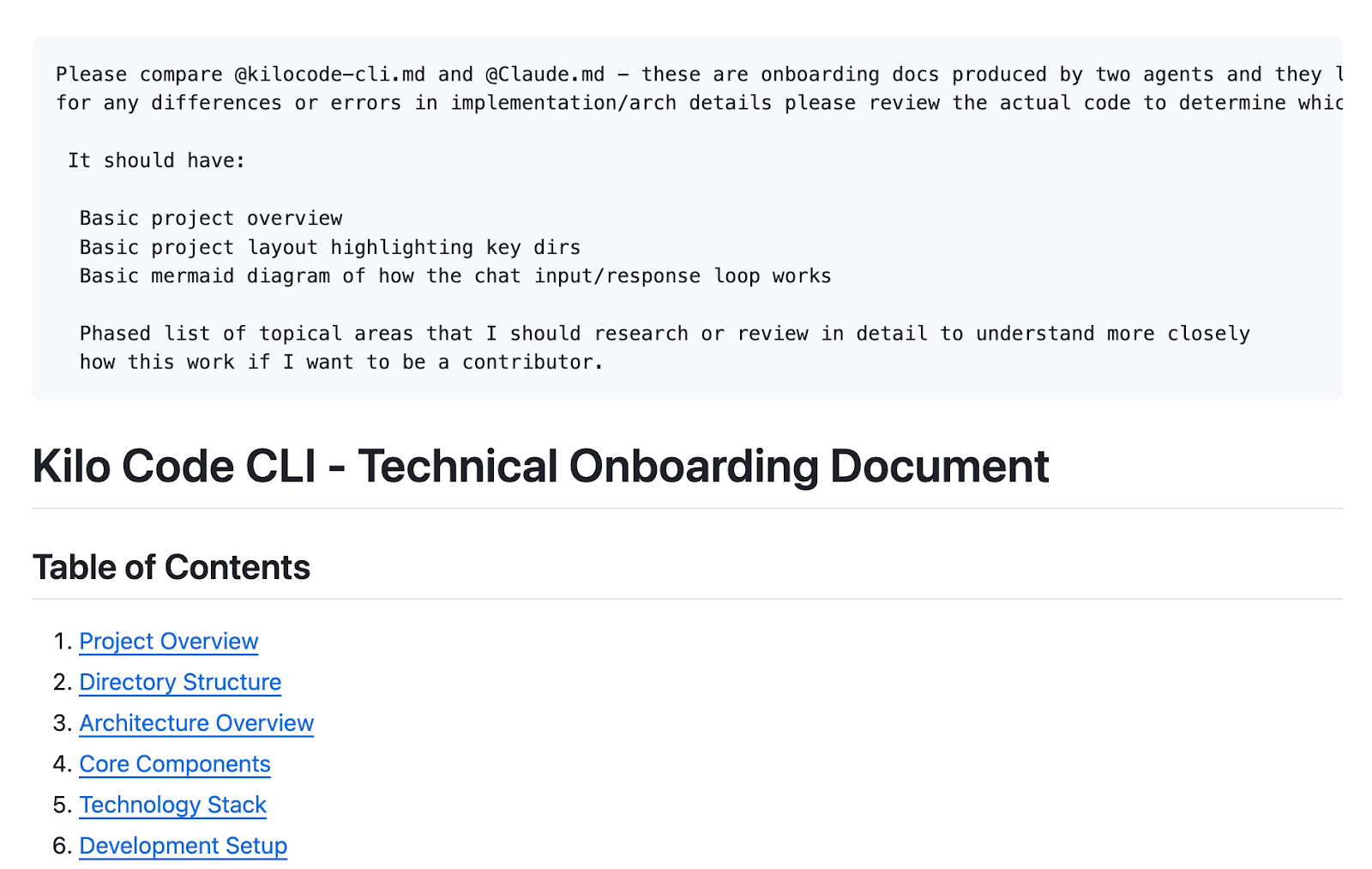
This preparation allowed him to spend the Monday morning architecting the Cloud Agent platform, rather than just learning how to run the build.
Navigating the Knowledge Gap of Emerging Tech
When moving at Kilo Speed, your choice of stack matters. Florian specifically chose the Cloudflare Sandbox SDK for the Cloud Agent foundation because of Cloudflare’s reputation for high-quality documentation. “I didn’t want the tech stack to torpedo me later with unknown ‘gotchas’.”
Developing an AI tool often requires working with “bleeding edge” technologies that haven’t yet made it into the training data of major LLMs. While an agent might have an “intuitive” understanding of React, it doesn’t know an SDK that was released two weeks ago. Even human experts on the team (like John, who worked on Cloudflare Workers for years) can have outdated knowledge because the pace of development is so fast.
“I’ll grab the SDK off GitHub and have that code live alongside what I’m working on. I have to teach the agent how to use the thing that we are both trying to work with. It’s a dual learning process.” If an agent refuses to use a feature because it believes the API doesn’t exist, Florian doesn’t argue—he provides proof.
3 Strategies for High-Velocity Delivery
Kilo Speed isn’t about putting in more hours; it’s about shifting to a fragmented, non-linear workflow that maximizes parallel output. Here are some ways that Florian works differently to ship fast:
1. The “No Rage-Quit” MVP
Shipping fast requires a specific mental framework for what “done” looks like. “I try to avoid anything that would make me ‘rage-quit’ the product,” Florian says. “There can be jank and missing features. But if the user says, ‘I wish it had this,’ that’s a pro—it implies they find the core product valuable enough to want more.”
This philosophy allowed Florian to ship the first iteration of Cloud Agents by the Thursday of his first focus week. It wasn’t perfect: there was no session sharing yet; if you closed your browser tab you couldn’t resume the real-time stream. It was really just designed for “one and done”-type tasks, but it was functional enough to start powering other Kilo features immediately.
2. Real-Life Jump Cuts
Traditional development is single-threaded. Florian’s process, like all Kilo engineers, is “parallelized”: firing off background tasks to agents while he switches context.
“There are lots of ‘real-life jump cuts’ in my work,” he notes. “I’ll drop a complex question or a planning task into the CLI or the Cloud Agent chat UI, and then I’ll go get coffee or work on a different problem. Hours later, I’ll come back and pick it up where the agent left off.”
3. Choosing the Right Medium
Florian uses different interfaces to manage his cognitive load. He avoids the editor when he’s in a planning phase.
“I use Architect Mode mostly from the CLI or Cloud Agent in a separate Chrome tab,” he says. “I have a hard time focusing sometimes, and being in the terminal focuses my field of view. It helps me lock in on the plan before I move into the IDE for implementation.”
The Agentic Toolbelt
To maintain quality while moving fast, Florian has built a specialized set of custom “modes” and scripts:
TypeScript Reviewer & Code Simplifier
During implementation with Orchestrator Mode, Florian runs these custom modes to catch logic flaws and prevent code bloat.
The deviations log
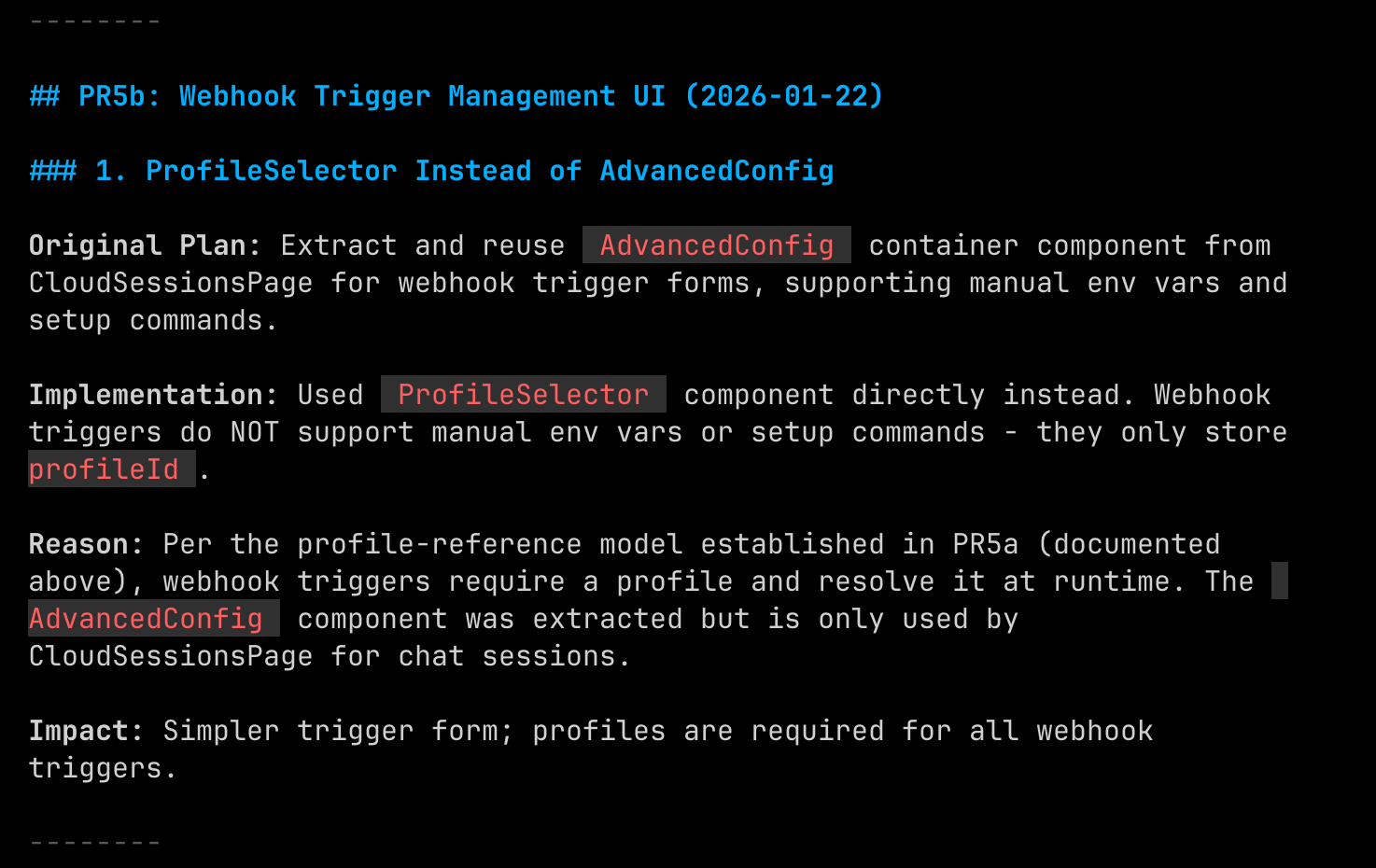
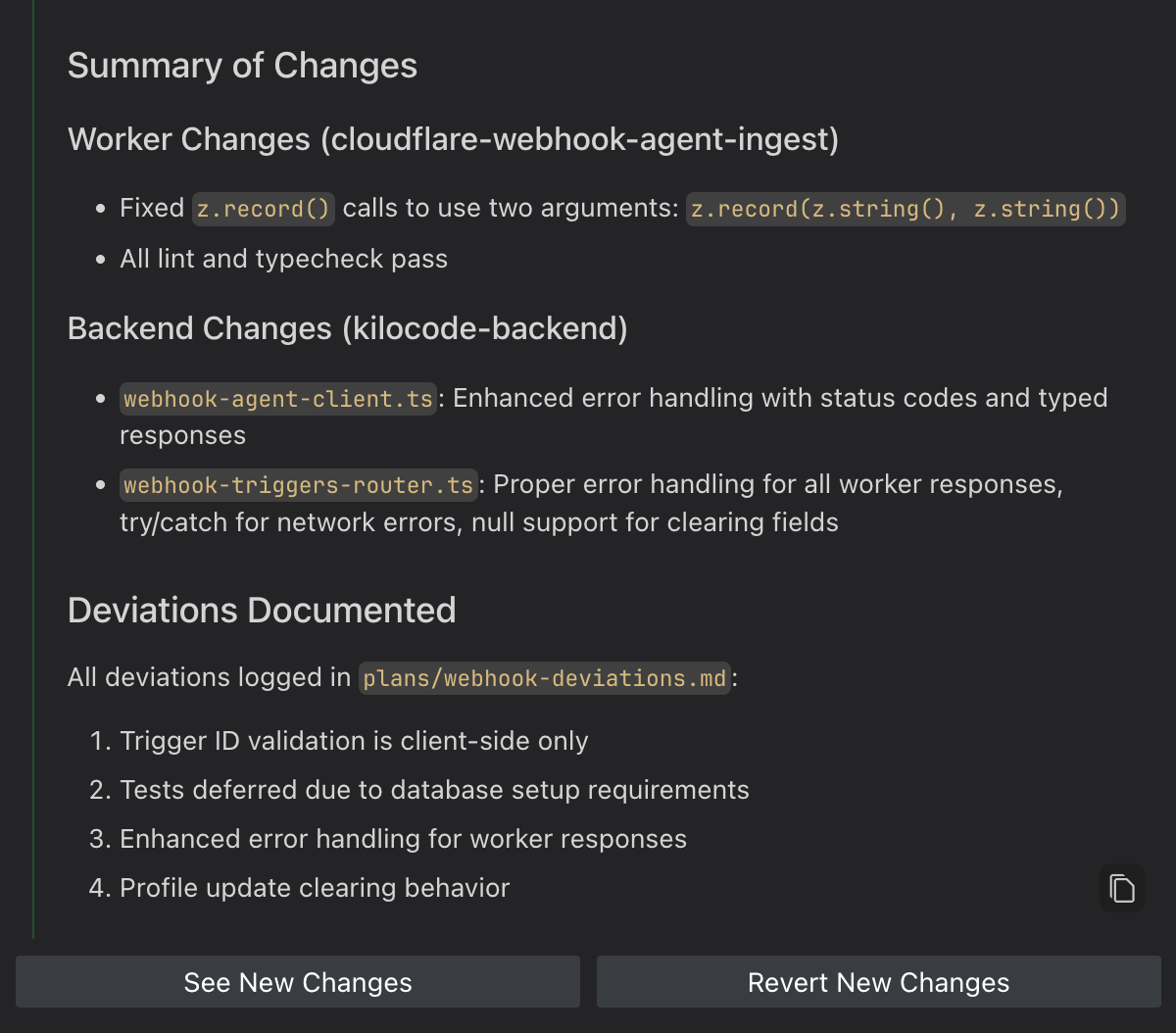
Florian requires agents to produce a log of every instance where they deviated from the original plan. “It saves me so much time during review because I know where the agent likely went off-script,” Florian explains. “It also helps follow-up sessions, because typically deviations that happen because I changed my mind and instructed the agent to do something different also get logged here.”
The prompt:
please review plans/pr5-webhook-trigger-ui.md we’re going to begin implementing the first pr. ALL deviations from the plan must be logged in a @plans/webhook-deviations.md
The log:
The output from Florian’s extension:
Repomix
When working across microservices, Florian uses a tool called Repomix to distill an external repository into a single document for the agent. “It’s huge for giving an agent context on a dependency that lives in a completely different repo.”
The Amplified Engineer
Operating at Kilo Speed is less about writing code and more about being the conductor of an automated orchestra. By using Kilo to research, study, and execute in parallel, Florian turned what would have been a month-long infrastructure project into a functional platform in seven days.
“It’s an amplified style of working,” Florian says. “It’s about figuring out how the tech stack works quickly enough so that the robots can start executing the work plan.”
Check out the other posts in this series:


The deviation log is the most underrated pattern here. When you're running agents against a plan, drift is inevitable — what matters is having a record of where it drifted and why. I do something similar with Claude Code: keep a PLAN.md and have the agent update it when scope changes. Saves hours during review.
The "rage-quit prevention" threshold for shipping is also real. If users find enough value to request features, you've already validated the core. Ship the skeleton, let real usage tell you what to add next. Most solo builders (myself included) over-polish before anyone's touched the product.
I haven't found the right prompt yet, but I've been thinking about how to create a deviations log for Kilo itself. Every time there's a process fail - a tool call, api timeout, task id missing, ..., anything that adds friction to what we're actually trying to do - add log entry to papercuts.md.
I'm not sure this should in the standard context itself because of the potential to derail the main task into recursive never-ending sidequests. Maybe a tool to inspect and review threads after the fact. Feels like something that could/should be baked into Kilo.