

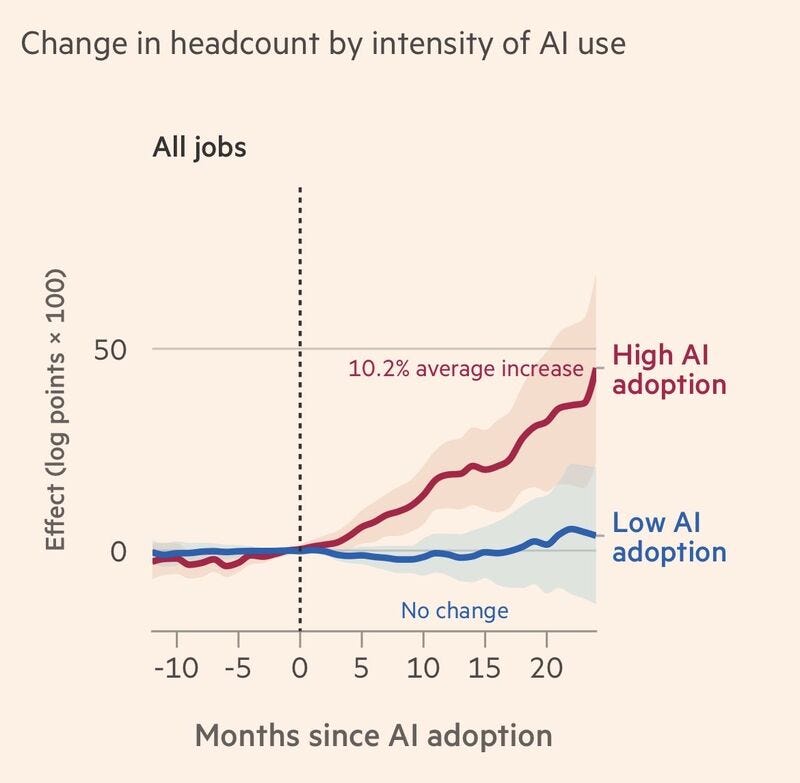
Contrary to what the headlines make you believe, companies that use AI heavily are actually growing their headcount, not reducing it. Wouldn’t it make more sense if the heaviest AI adopters were reducing their headcount, because they can do more work with fewer people?
Meanwhile, the five companies paying for much of the compute that powers this AI usage have seen their combined cash flow fall by nearly 90 percent in 18 months. They have sunk enormous sums into compute over the last few years, and that spending has to start showing up as cash flow soon. At the same time, the frontier labs behind these models are heading toward some of the largest IPOs in history, and their valuations assume token consumption and revenue keep climbing. This creates real pressure on pricing and growth.
But not all is doom and gloom. The case I’m making is to learn from AI power users, and to plan for what’s actually happening instead of what the headlines tell you.
AI scales ambition
Let’s start with the good news. Ramp and Revelio Labs linked spending data to workforce records for 21,559 U.S. firms and found that companies making the largest AI investments grew headcount by 10 percent over the two years following adoption. Entry-level hiring grew even faster, at 12 percent. Firms that adopted AI lightly saw no significant change either way, up or down.
Box ran a separate survey of 1,640 companies and landed on the same pattern from a different angle. Fifty-eight percent of respondents expect headcount to rise over the next three years. Among the most AI-mature companies, that number climbs to 79 percent. Only 9 percent say AI agents are primarily eliminating roles today.
The reason is simple. A company that can serve more customers because AI handles account research hires more salespeople to close those accounts, not fewer. A team that can ship more software takes on bigger projects and needs more engineers to run them. AI is expanding what companies believe they can achieve. And there’s a compounding effect: teams that work with AI extensively learn how to build with it. We see this at Kilo all the time, it takes hands-on time before a team really ships faster.
Their growth pressure becomes your bill
Now the part that's going to create friction soon. Apollo’s chief economist has been tracking twelve-month forward free cash flow across the five companies funding almost all of this: Microsoft, Amazon, Alphabet, Meta, and Oracle. That number peaked near $300 billion in late 2024. It has since fallen to roughly $40 billion. And most of that decline happened in just the last few months.
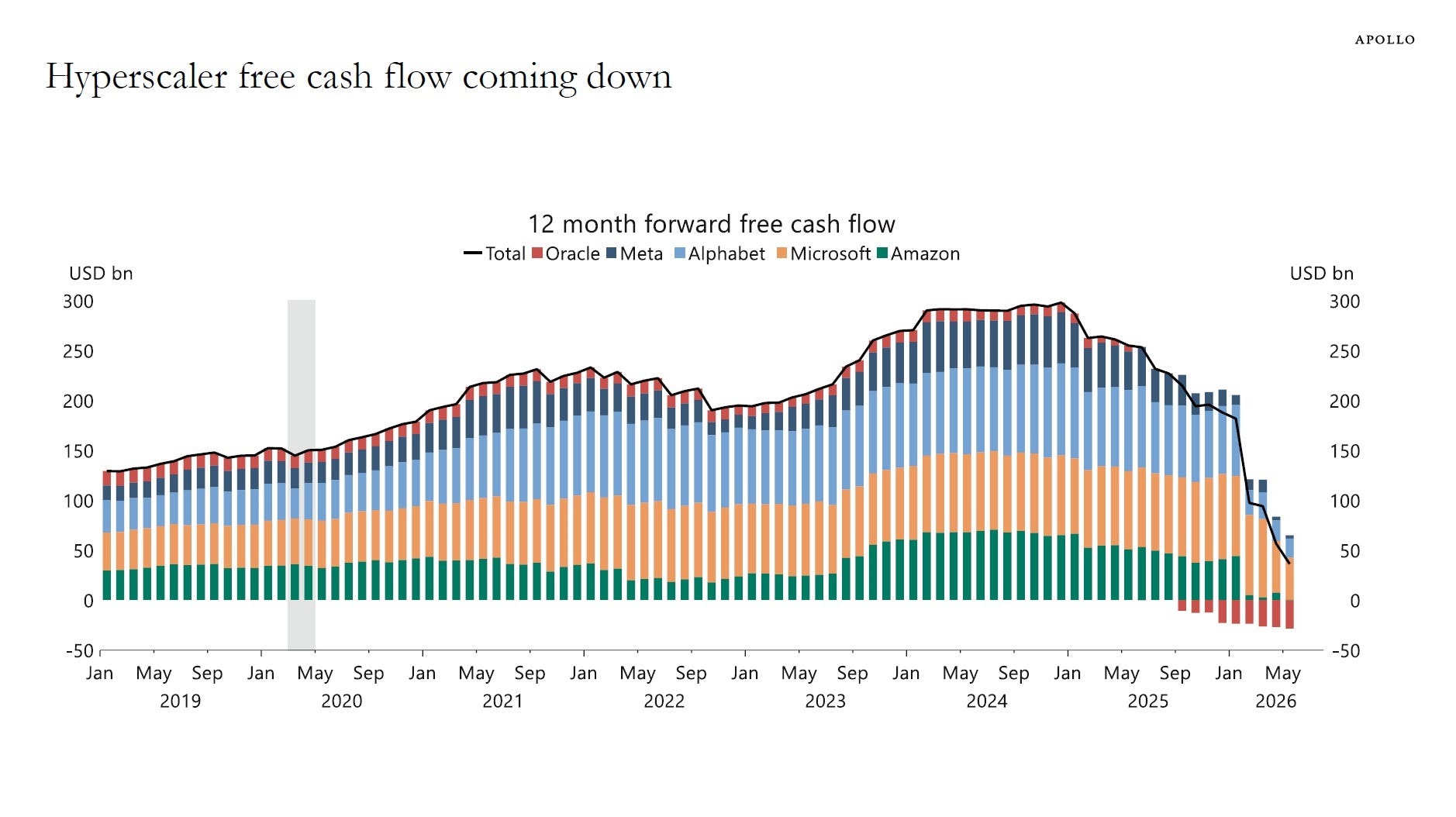
The gap between what’s been invested and what’s actually coming back is what creates the pressure. One of the main levers we'll see more and more companies use is pricing. And that isn't a hypothetical scenario. We saw the effect recently when GitHub flipped Copilot to usage-based billing. All of a sudden, instead of a fixed seat cost, engineering leaders had to deal with their per developer bills increasing from tens to thousands.
Nobody knows who captures the value
The honest answer is that nobody knows how this resolves, including the companies making the bet. Railroads in the 1800s and fiber in the late 1990s ran on the same logic: massive buildout now, outsized returns later. Both were right about the technology and wrong about who would capture the value. When everyone builds the same thing at the same time, nobody gets to charge a premium for it for long, and the value tends to settle somewhere else. What we do know is that the AI pricing pressure has already started to trickle down to its users.
That’s why you need an open layer
If your team’s plans assume today’s model pricing, availability, and vendor terms simply continue, you are walking on very thin ice. We’ve written before about what that looks like up close: a frontier model can be the best option one week, and access pulled entirely the next one.
You cannot predict who captures the value, but you can rest assured that your bills will continue to pay off the hyperscalers’ bets. The one thing in your control is how dependent you are on a single vendor. The heaviest AI adopters don’t stand on one flagship model, they mix models and vendors and route each task to whatever fits it best. Coinbase just showed what that looks like in practice, cutting its AI spend nearly in half while token usage kept climbing.
An open layer that prevents vendor lock-in and routes work across models and providers is how you build a workflow that lasts.
I have been saying this for a long period now , but there was a blogger on another platform stipulating that presently the loophole was the fact that Juniors or being hired for tasks handling with AI but these were done quite rapidly. These causes leaders to 🚭 be able to use the RH properly as they do not have enough experience for advanced tasks and job roles like project manager or data engineer. They would keep him/her but they don't to pay the senior level job, this is in my view a major predudice as ⛔ level jobs are not entry level amymore when expecte is a hiring criteria
I have been saying this for a long period now , but there was a blogger on another platform stipulating that presently the loophole was the fact that Juniors or being hired for tasks handling with AI but these were done quite rapidly. These causes leaders to 🚭 be able to use the RH properly as they do not have enough experience for advanced tasks and job roles like project manager or data engineer. They would keep him/her but they don't to pay the senior level job, this is in my view a major predudice as ⛔ level jobs are not entry level amymore when expecte is a hiring criteria