


Africa at 30,000 feet
I’m sitting on the staircase that faces the Voltron Room at STATION Austin, waiting for Monday’s keynote at Austin Tech Week 2026 to begin. My random playlist starts to play Toto’s “Africa.” Its intro casts a spell. Suddenly I’m back in my window seat on a LADECO flight from Bogotá to Miami. It’s 1991 and the scene is probably my earliest memory of traveling to the U.S. Summer clouds and Caribbean blue pass below us as the song blasts through the headphones plugged into my armrest. Next to me, my cousin Irene; in the aisle seat, my grandmother, Mamama.
I snap out of it as the stewardesses open the doors and people start trickling in. Heather Brunner, chairwoman and CEO of WP Engine, is about to begin her keynote on Keeping Austin Bold. Her main theme in a nutshell: Austin sits at a rare convergence. Five frontier industries accelerating at once on top of 50 years of chips, software, and AI. Our best days are yet to come, paraphrasing her, but only if people are bold enough to match the moment, and boldness depends on personal resilience. The event’s first day, co-hosted by Austin Women in Technology (AWT), ends with a promising prognosis of the challenges ahead.
The first woman in tech
We land at Miami International Airport and rent a van for the whole family. My aunt, who lives there, joins us, and we head off to Walt Disney World. Mamama’s trip has two goals: take her grandkids on an unforgettable vacation and, on our way back from Orlando, get the family’s first Nintendo Entertainment System (NES). Not for us, but for her. She acquired two consoles (I now realize) and kept one well hidden until “El Niño Dios” (our version of Santa Claus) made mine appear by the Pesebre, a Latin American tradition recreating the nativity scene, where kids find their coveted Christmas gifts.
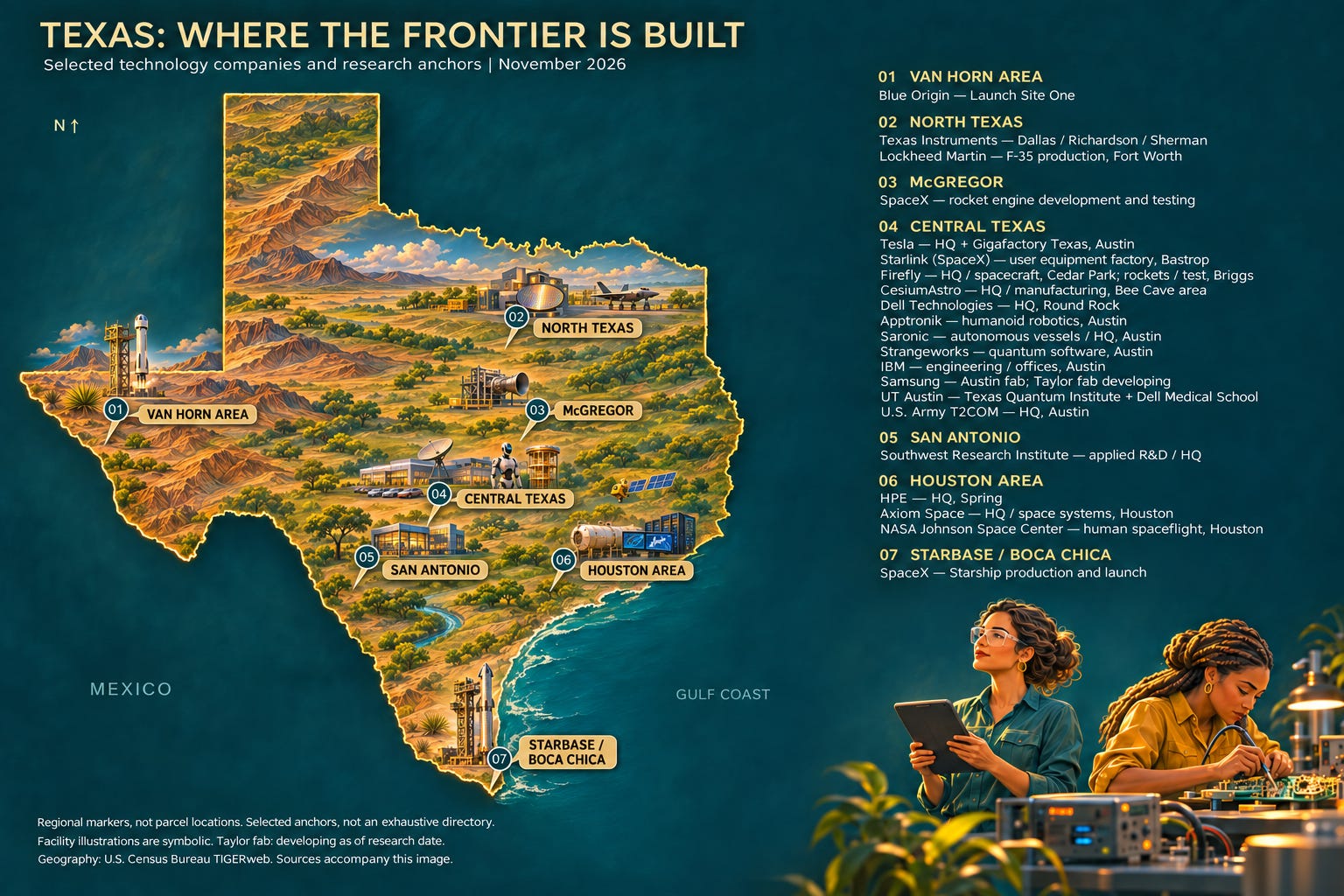
How far we’ve come from 8-bit technology. And Austin is a living landmark of that evolution. Back to Heather’s argument, each era has laid the foundation for the next. The intersection of government, universities, and tech titans long established in town: IBM, Texas Instruments, Dell, etc. Weird as Austin is, the city has only sped up since COVID. Heather went on to describe the five frontier industries now accelerating on top of that foundation: space, with Firefly Aerospace, CesiumAstro, and SpaceX; quantum, with University of Texas research and Strangeworks; defense, with Saronic and the Army Futures Command; robotics, with Apptronik, whose Series A has passed $935 million; and biomedicine, with Dell Medical School. “Very few places on Earth” have all of this happening at once.
Someone asked Heather what she looks for in engineering leaders now that AI is changing how teams work. Her answer: curiosity and closeness to the customer. “You can build a lot of cool things really fast. You can burn through the tokens. But then what are you gonna deliver?” What she meant was customer value. I’d add that in industries where a mistake can ground a spacecraft or expose patient data, delivering also means knowing which model your sensitive code goes to, testing agents before they reach production, and not betting everything on one model, as I wrote in “What Colombian Coffee Growers Can Teach Dev Teams About Model Lock-In.”
Curiosity was the first trait Heather named in engineering leaders, and Mamama had it to spare. She was the first woman in tech I knew. I have yet to meet anyone who can say their grandmother finished The Legend of Zelda 1 & 2, Final Fantasy (the primordial one), Castlevania, and The Battle of Olympus, to name a few. While other kids wore the sweaters their grandmas knit or brought their homebaked pies to school, I watched mine beat Ganon, Dracula, Hades, and Garland (who respawns as the final boss, Chaos).
Five industries, six notable women
Heather’s map comes with a matching roster of women running those frontiers, in Austin and beyond. In space, Gwynne Shotwell has been SpaceX’s president since 2008, runs much of its day-to-day operations, and in June 2026 took it public. In quantum, Michelle Simmons, founder of Silicon Quantum Computing, builds qubits one atom at a time in silicon. In defense, Kathy Warden has led Northrop Grumman as CEO since 2019.
The next two connections lead back to that staircase facing Voltron. From the Bay Area, Carolina Parada leads robotics at Google DeepMind, whose Gemini Robotics model controls Apptronik’s Apollo 2 “from feet to fingertips.” Apptronik is the Austin humanoid maker Heather put on her map, and it has worked with DeepMind since December 2024. Up the road from STATION Austin, Dr. Claudia Lucchinetti left Mayo Clinic to become dean of Dell Medical School in December 2022, and in October UT Austin named her executive vice president for medical affairs. As Heather pointed out, the school didn’t exist 15 years ago. This May, Dell Med announced a new Department of Quantitative and Systems Health Sciences and named Hongfang Liu its inaugural chair and chief translational AI and informatics officer for UT Dell Medical Center.
In Spanish, la resiliencia is a feminine noun
Heather tied boldness to personal resilience. Before her keynote, Monday’s stages belonged to builders who had already tested theirs. Kristin Bonds, who is co-hosting the third season of the Femme Founder Bootcamp with Megan Murray, opened with the numbers she builds against: women own about 40% of US companies but get only 2% of venture funding, and, she said, are 55% more likely to close a business for family reasons. Then she told us her own story. A couple of years ago, she and her co-founder at Heristic, a firm that helped startups build inclusive hiring, parted ways. Around the same time, a client broke her heart and left her questioning her work in diversity, equity, and inclusion (DEI). She almost hung it up. Instead, she pivoted into operations and AI, and told the room she’ll always be doing that work.
Her wisdom nuggets: pivoting is part of the path, opting out of entrepreneurship isn’t failure, and mentorship is currency. One of her founders, Lynn, didn’t feel ready for a local pitch competition. Kristin and Megan’s advice was mostly “just do it,” and Lynn won $25,000 the first time she ever pitched. “Ships are safe in port,” Kristin said, “but that’s not what ships are for.” She also sees a wave of “accidental entrepreneurs” coming: empty nesters and curious people who pick up an AI subscription just to solve a problem in their own lives, building alone for longer, “for better or worse.”
Then Melissa Wood, a serial entrepreneur, spilled the tea on her own path. Last year she bootstrapped her startup past $200,000 in revenue on a prototype. This May, the beta didn’t get adopted, her co-founder relationship broke, and she burned out until her doctor told her to stop. It wasn’t the first time life ignored her plans: in 2009, the day before a career-making project was confirmed, she was diagnosed with cancer. “I didn’t get to pick the timing,” she said. “Of course, I picked the treatment.” Melissa’s new venture, Curaite, started as something she built for herself, and 3,400 people used it in three weeks. This time she stepped back first, named the 30% she was missing, and brought in a team. “70% is enough to start,” she told the room. “You just have to know what your missing 30 is.” Her advice to anyone starting, dev teams included: know what you’re missing, and bring in people who can help. It was a room packed with women, and we men were invited to listen, learn, and collaborate.
Our side of the bargain
The week before Austin Tech Week, we ran our own conference. Of the 137 speakers at All Day AI 2026 (ADAI), 38 were women, about 28%. They made up 41% of our LEAD track and 45% of SHIP, but only 13% of BUILD, the engineering stage. “Women account for only around 22 per cent of artificial intelligence professionals globally and hold fewer than 14 per cent of senior leadership positions,” according to UN Women. Overall, we came in above that number. On BUILD, the stage made for engineers, we fell well short of it. We hope to right this wrong next year and put more of their work on the BUILD stage.
My early years were deeply influenced by women. Not only Mamama, but Mom and her three siblings (my tías), “my poker of queens,” as Grandpa used to say. My older cousin, with whom I had the pleasure of traveling on those trips, and my sweet sister, who arrived five years after me. Dad, my uncles, and Grandpa were part of the family too, but we all knew ours was a clan of powerful and empowered matriarchs.
For similar examples I don’t have to look far. Emilie Schario co-founded Kilo (check out her talk at ADAI, “Your AI Coding Bill Isn’t the Problem”) and now serves as VP, Engineering at Anaconda. At Anaconda, four of the eight people on the executive leadership team are women, including our two co-presidents, Jane Kim and Laura Sellers.
Olesya Elfimova, Kilo’s former chief of staff and an All Day AI co-founder, supported me on the call that brought AWT on as a community sponsor for ADAI 2026, thanks to Yousra Magouri, who also contributed and presented on our SECURE track. I had the pleasure of finally meeting Yousra face to face during Austin Tech Week. I want to build on that partnership with her and AWT as we shape ADAI 2027.
Here’s what I’m thinking about for next year, and what I’d recommend to other event and DevRel teams. Let’s do the count before announcing: who’s onstage and who’s at the organizing table. I am glad we engaged a community like AWT early enough to help shape the lineup, not just share the registration link. Heather’s own advice: “Show up, and open a door for somebody.” It’s how we pay it forward.
Mamama is 93. She don’t videogame no more (she’s outlived her NES’s functional life). Still, her immense curiosity and open-mindedness drive her to ask me questions about what I do, what AI is, and how it works, while playing solitaire or assembling puzzles on her tablet. Listening to Heather, Kristin, Melissa, and others reminded me of the woman I grew up watching defy assumptions about who technology was for, and who has never stopped being curious about it.
I once promised her I’d take her back to Disney, just like she did a couple of times with us. “Even in a wheelchair,” I remember saying as a kid. I haven’t kept that bargain, yet.