

After five years, Warp open-sourced their terminal client this week. The code is on GitHub, the blog post is up, and the messaging hits all the usual notes: community collaboration, agent-powered workflows, building the future together.
But if you zoom out even slightly, the timing tells a more interesting story than the blog post might suggest.
Five Years Later…Why Now?
Warp’s original Show HN post from 2022 said the plan was “always to open source the client.” CEO Zach Lloyd acknowledged in this week’s announcement that they’ve debated going open source every single year since launch, and every year the answer was no.
So what changed?
Well, look at the calendar. Roo Code, which had accumulated over 3 million installs and one of the most active contributor communities in the AI coding space, announced it’s sunsetting the project on May 15th. Cursor, the dominant closed-source IDE, is set to be absorbed into SpaceX’s $60 billion AI play. Two of the biggest names in AI-assisted development are either shutting down or getting swallowed by a conglomerate in the same month.
If you’re Warp, and you’ve been sitting on a closed-source terminal for half a decade, that’s a land grab opportunity.
Lloyd frames the decision as a natural response to the rise of agents, which I have no reason to doubt. But it also happens to coincide with a moment where every competing product is either pivoting, dying, or getting acquired. The field is wide open, and going open source right now is as much a competitive move as it is a philosophical one.
Open Source - With an Asterisk?
Here’s where things get a little awkward.
Warp’s open-source announcement leads with OpenAI as the “founding sponsor” of the repo. The contribution workflow runs through Oz, their proprietary orchestration platform, and that workflow is powered by GPT models. They say you’re “free to use other coding agents,” but their stated preference is Oz since it has “the correct skills and verification loops built-in.”
Think about that for a second. They open-sourced the client, but the recommended way to contribute to it runs through a proprietary platform backed by a single AI provider. A truly open IDE experience makes it as easy as possible to switch between models freely - with no one provider dominating or controlling the experience.
To be fair, Warp does support BYOK (Bring Your Own Key) for Anthropic, Google, and OpenAI on paid plans. But BYOK on a paid tier isn’t the same thing as true model freedom that’s built into the product. It’s model freedom* with a billing prerequisite.
And their AI features still depend on Warp’s backend services, so even if you build from source, you’re not getting a fully self-hosted experience. The code is open; the platform around it is not. Kilo’s backend has been source-available since February 2026.
The Community Reaction Means Something
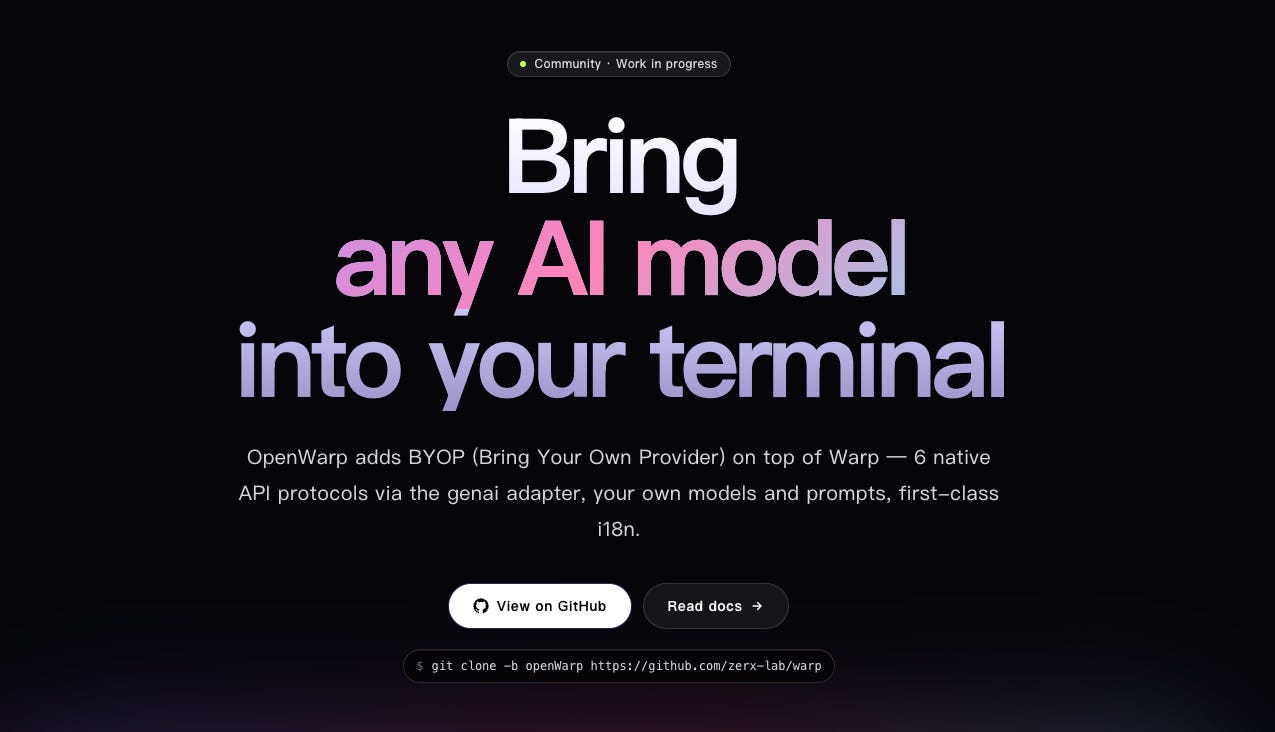
Developers don’t tend to wait around when they see an artificial constraint on an open codebase. Within days of Warp going open source, a community fork called OpenWarp appeared.
Its entire value proposition? Let you plug in any OpenAI-compatible endpoint you want: Anthropic, DeepSeek, Ollama, Groq, OpenRouter, local models, whatever. No relay, no paid tier requirement, just point it at a base URL and go.
The fact that this fork materialized almost immediately says something. The community looked at Warp’s version of “open” and decided it wasn’t open enough.
You Don’t Need to Fork Warp for Model Freedom
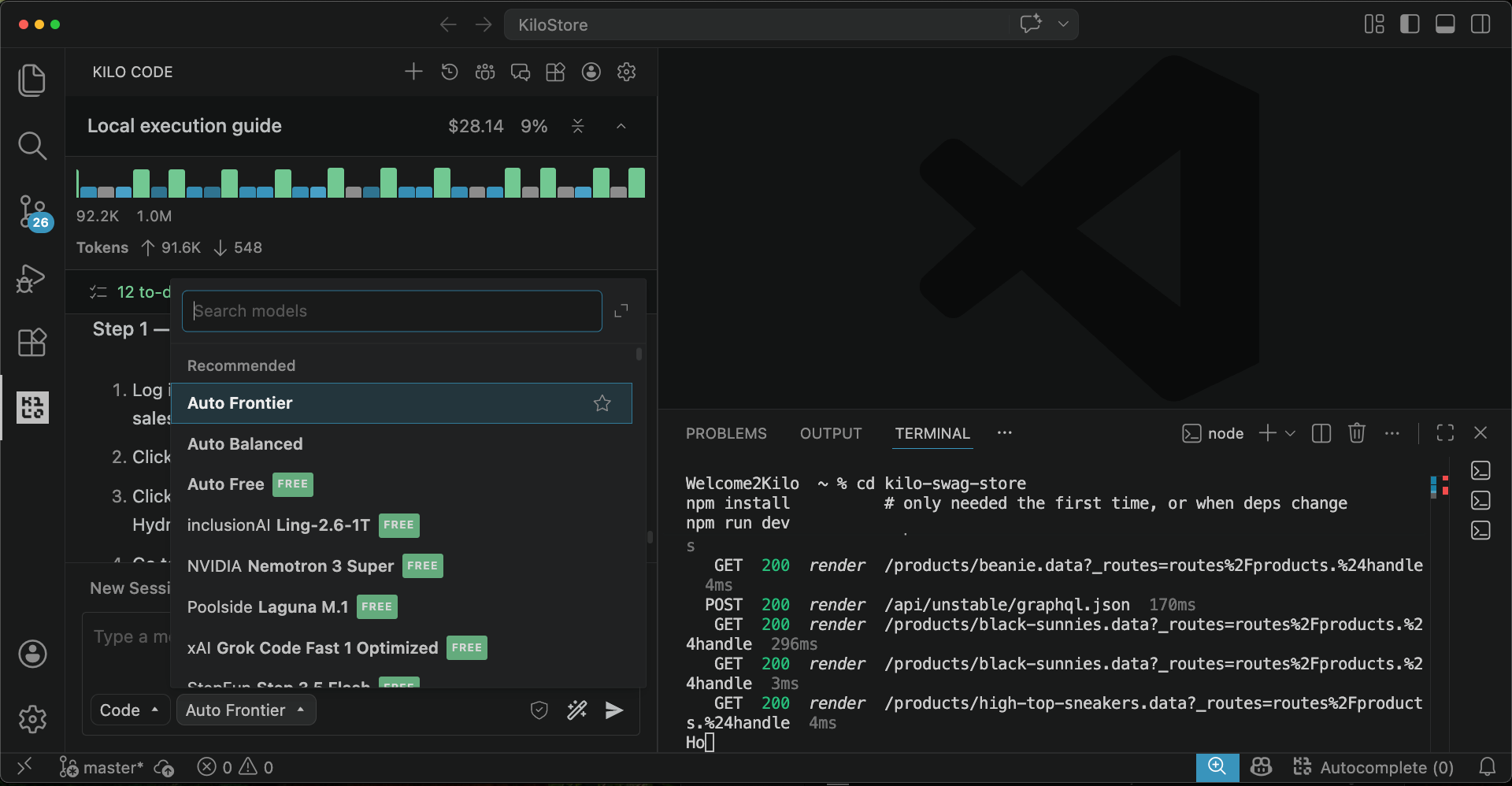
Here’s the thing: if the feature you actually want is model freedom in an AI coding environment, you don’t need to fork Warp to get it. You just need a platform that was built with model openness from the start.
That’s what Kilo does. Over 500 models available through the Kilo Gateway, all at provider cost with zero markup. No single-vendor sponsorship deals dictating the contribution workflow. No paid tier unlock to bring your own keys. You pick the model that fits the task, switch between them whenever you want, and pay only for what you use.
Where Warp is retrofitting openness onto a five-year-old closed codebase with a corporate sponsor attached, Kilo was designed from day one around the idea that developers should control their own stack. No walled gardens, no preferred vendors, no asterisks.
Reading Between the Lines
Warp going open source is a good thing at the end of the day. More open code is better than less, full stop. And the agent-first contribution model they’re experimenting with is interesting, regardless of who’s sponsoring it.
But the framing matters here. Open source that routes you toward a single AI provider’s orchestration platform is a different animal than open source that lets you bring whatever you want to the table. When the community forks your project on day one specifically to remove vendor constraints, that’s feedback worth paying attention to.
The AI coding tool landscape is consolidating fast. Roo Code is saying goodbye. Cursor is mid-acquisition. Warp is scrambling to reposition. In a market moving this quickly, the tools that survive will be the ones that give developers real control over their models, their data, and their costs, not the ones that dress up vendor lock-in as community collaboration.