

Last week was another wild one for new model releases, with everyone from Anthropic to Meta launching new flagship models. And if you blinked, you missed one of the most significant frontier models for agentic engineering.
Almost nobody seemed to notice that Google shipped Gemini 3.8 Flash on Wednesday, with about as little fanfare as a frontier lab can manage. No keynote. No “we’ve overtaken so-and-so” press cycle. Just a blog post, a model card, and a new API string.
We got the new Gemini flash model live in Kilo the same day it launched, and it’s already becoming a daily driver for developers with a budget to support it. So let’s talk about why the quietest launch of the week might be the one that matters most for your daily driver.
The Numbers Nobody Is Talking About
Here’s the headline that got buried: this model is extremely smart for a flash model, multimodal, and actually pretty affordable when caching works well.
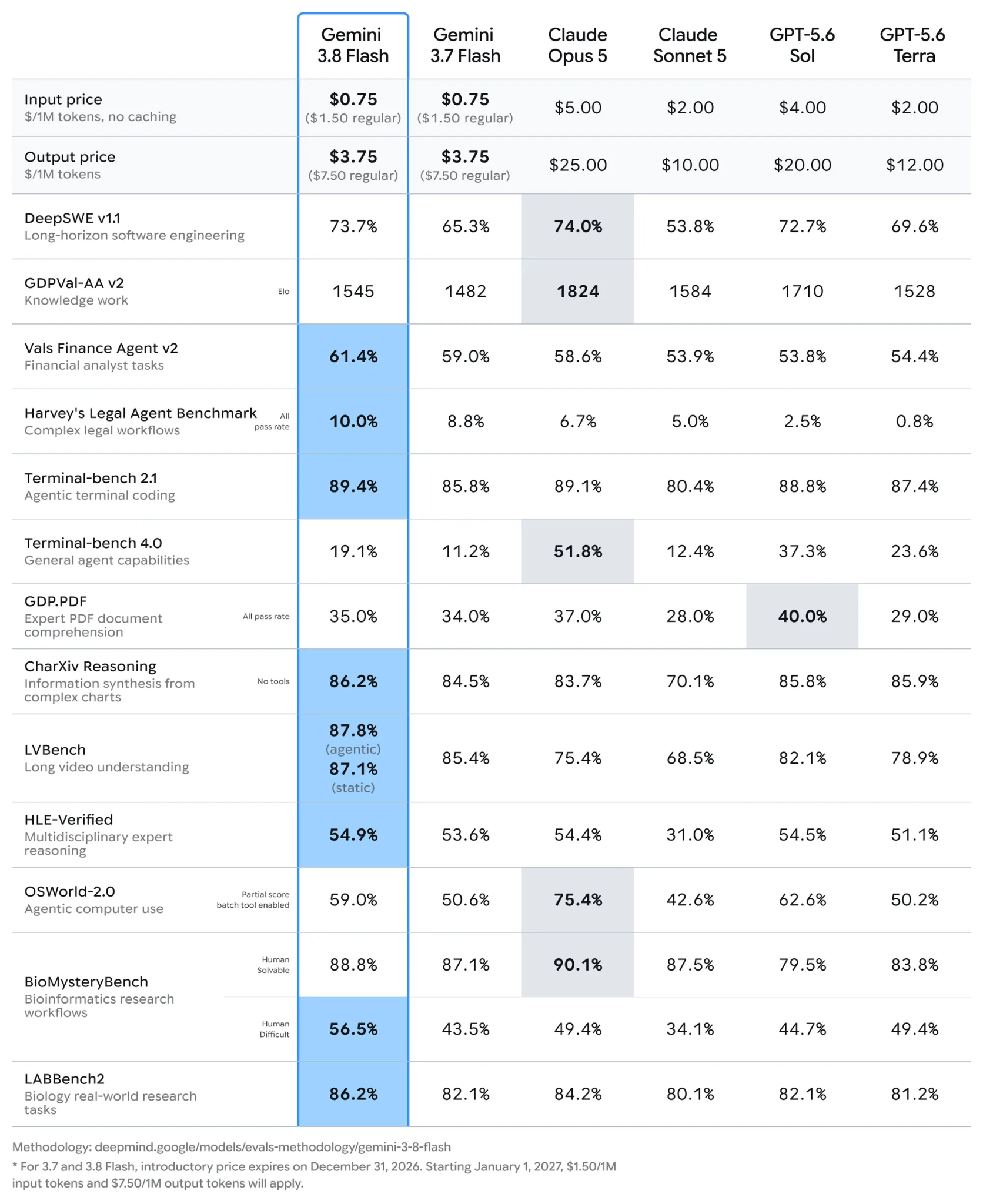
Price: $0.75 / million input tokens; $3.75 / million output tokens (introductory pricing through December 31, then $1.50 / $7.50)
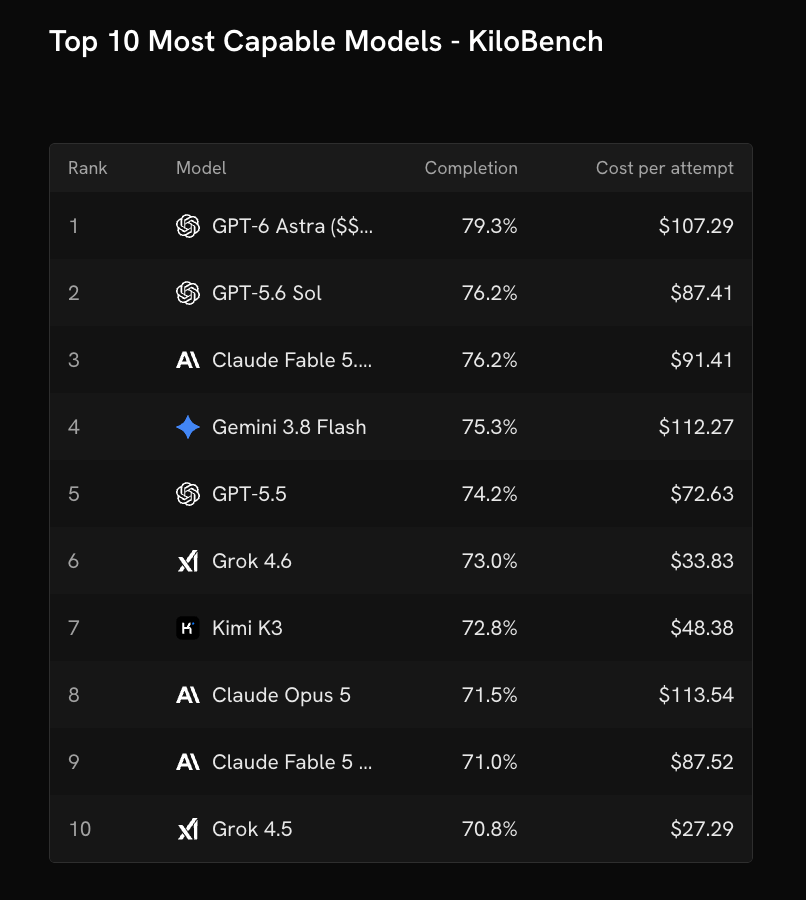
KiloBench: Gemini 3.8 Flash scored an impressive 75.3% on KiloBench, higher than GPT-5.5 but at a higher cost
Intelligence: 59 on the Artificial Analysis Intelligence Index at high effort; that’s level with GPT-5.6 Sol at extra high, and level with Grok 4.6 at medium
Context window: 1 million tokens, no long-context surcharge
Effort levels: Fully adjustable, so you can dial token spend down for boilerplate and up for the gnarly stuff
Back in May, Gemini 3.5 Flash was a very good budget model that was getting lapped on intelligence scores by open-weight releases out of China. Four Flash iterations later, 3.8 Flash is sitting on the same rung as the models people argue about on social channels.
Google’s own DeepSWE v1.1 results show it solving long-horizon software engineering tasks end to end at a level that beats most larger frontier models. On HLE-Verified it hits 54.9%. And it’s showing up strong on the finance and legal agent benchmarks too, which matters if you’re building agents that have to do more than write code.
Gemini 3.8 Flash vs Grok 4.6
I keep coming back to Grok 4.6 because it’s been the value story of the summer, and deservedly so. xAI held the line at $2 / $6, roughly 60% cheaper than Opus 5 or GPT-5.6 Sol, and the Kilo community has been putting it to work in long-running agent loops. Right behind it on our leaderboard is GLM-5.3, Zai’s open-weight workhorse that has quietly become a favorite for the same kind of work.
On Artificial Analysis’s Intelligence Index, the three are basically neighbors: Grok 4.6 at 61, GLM-5.3 at 60, Gemini 3.8 Flash at 59. Two points on a composite of nine benchmarks is noise. Nobody is picking between these models on intelligence.
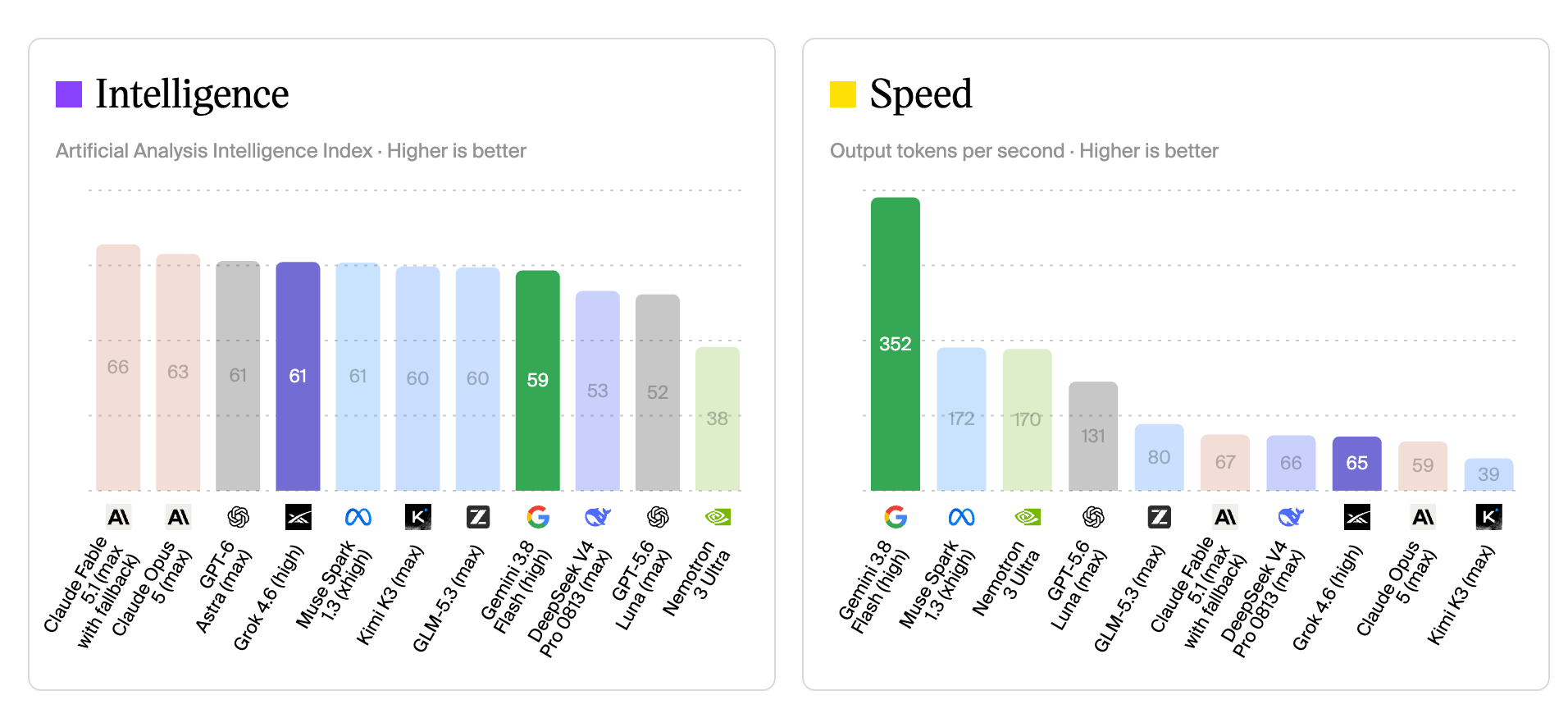
Where they stop being neighbors is speed. Artificial Analysis clocks Gemini 3.8 Flash at 352 output tokens per second. GLM-5.3 comes in at 80. Grok 4.6 at 65. That’s not a rounding error; it’s roughly 4x faster than GLM and 5x faster than Grok, at the same tier of intelligence.
In practice, that’s the number you feel. An agentic loop is dozens of model calls stacked on top of each other, each one waiting on the last. At 65 tokens per second, a 40-step task is a coffee break (or a matcha moment).
Then there’s the bill. At $0.75 / $3.75 list, Gemini 3.8 Flash is already well under Grok’s $2 / $6. But you pay for speed, and the costs can add up. 3.8 Flash works harder. On complex tasks it takes extra reasoning steps and calls tools more iteratively, so at higher effort levels it can burn more tokens than 3.7 Flash did. Cost per token isn’t cost per task. But our early runs suggest the extra diligence pays for itself on multi-step agentic work. Cached input is just $0.075 per million tokens.
Third Flash in Six Weeks
When we heard about the new release from Google DeepMind, Zoom out and the cadence is the real story. Gemini 3.5 Flash at I/O in May. Then 3.6. Then 3.7 Flash three weeks ago. Now 3.8. Google is shipping a new Flash model roughly every month, and each one has been a meaningful step up on coding and agentic work rather than a point release with a new number.
That’s exactly the dynamic I was predicting back in The Age of the Flash Model: the Flash tier stops being “cheaper if you just need basic stuff done” and becomes the default tier for always-on agentic engineering. Frontier intelligence is table stakes now. The competition is on cost per task, throughput, and whether the model can stay on the rails through a 40-step tool-calling loop.
Even the notoriously tough crowd over on r/google_antigravity is warming to this one, which tells you something. That’s a subreddit that has not historically handed out participation trophies.
And it’s not just independent developers who are taking to Gemini. Alongside the workhorse model, Google shipped Gemini 3.8 Flash Cyber, a defenders-only variant tuned for vulnerability discovery and automated patching, gated behind the new Fairwind Program for governments, critical infrastructure operators, and software maintainers. The Chrome Security team says it produced 2.6x more correct vulnerability patches than much larger commercial models.
Flash Models Are for Builders
Fable 5.1 and GPT-6 Astra are extraordinary. If you’re making a big architectural call or migrating something you can’t afford to get wrong, route it to whichever frontier model you fancy this week—they’re in Kilo alongside everything else, and Auto Model will happily pick for you.
But the model you’re going to run hundreds or even thousands of times a day, in the background, in a loop, on tasks that used to cost real money? That’s a Flash model now. And if you’re looking for both speed and functionality, you should reach for Gemini 3.8 Flash.
The loudest launch isn’t always the one that ends up above the fold. My money says little ol’ Gemini Flash is about to have a very big September ;)