

If you blinked this week, you already missed a lot in the AI development space. First, Cursor dropped the new version of their own model (which the community suspects might be a version of Kimi K2.6). Then, SpaceX’s recent IPO filings incidentally revealed that xAI burned through a staggering $6.4 billion last year, proving that their infrastructure spending is far from over.
But xAI, a part of SpaceX, didn’t just make financial headlines this week—they also quietly rolled out Grok Build 0.1.
So quietly, in fact, that you might have missed it.
We’re excited to announce that the new model from xAI is live in Kilo. Take advantage of our early access to give the new coding model a spin today.
Built for Agentic Engineering
Designed specifically to tackle complex, autonomous software engineering workflows, Grok Build 0.1 is positioned to rival the best coding models on the market. It’s already live in early access, and here is a breakdown of what makes it stand out.
Unlike standard chat models, Grok Build 0.1 is heavily optimized for interactive coding agents, tool use, and multi-step development tasks.
It is built to reason through a problem, write code, use your terminal, check for errors, and fix its own mistakes in a continuous loop. To support this “long-horizon” workflow, Grok Build 0.1 features a 256K context window (accepting both text and images) and currently boasts no text output limits. Instead of hitting an 8K token cap and forcing you to type “continue generating,” it can autonomously refactor massive codebases in one go.
It’s also just ridiculously good at building. This was the vibe with Grok Code Fast 1 as well—good at creating landing pages and product pages in a particular style, from coding to design—but Build seems to take it to the next level with fast iteration and better one-shotting. For example, it built a professional-level landing page in 40 seconds. For less than ten cents.

If our early testing is any indication, Build 0.1 is going to be a lot of folks’ new daily driver—super fast and more cost-effective than similar frontier models.
Grok Build 0.1 vs. Grok Code Fast
If you’ve been tracking xAI, you might be wondering how this compares to Grok Code Fast (recently deprecated) and other Grok models. TLDR: Build 0.1 aims to be more cost-effective without sacrificing large-scale coding abilities.
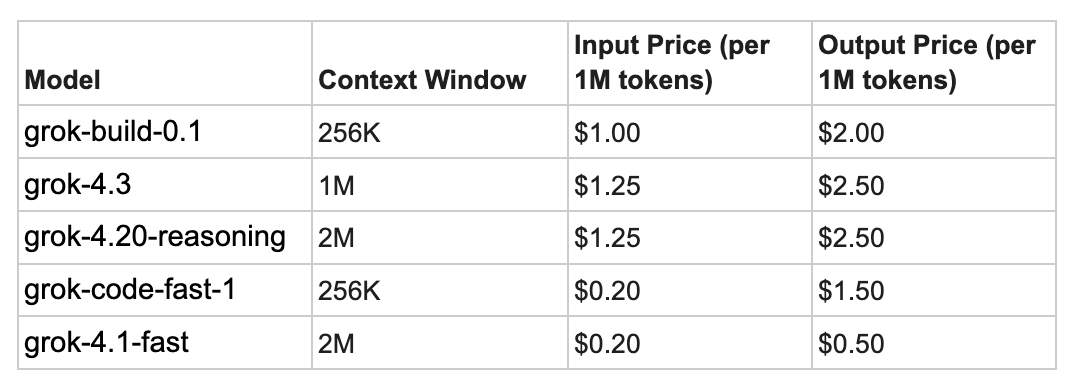
When Grok Code Fast went paid, it was a turning point for the industry. The release of Grok Build 0.1, a different type of model with a similar personality, proves that xAI is still focused on fueling agentic engineering.
Use Case: Grok Code Fast is your autocomplete and quick-refactor king—designed for instantaneous, low-latency edits while you type. Grok Build 0.1, on the other hand, is the “architect.” You hand it a massive Jira ticket, step back, and let it churn through the codebase.
Pricing: Grok Build 0.1 operates in that highly efficient “Flash” tier sweet spot. Priced at just $1 per million input tokens and $2 per million output tokens, it is built to be economically viable for agentic loops. This is the kind of cost-efficiency needed to let agents run wild.
When it comes to keeping costs in line, just remember that there are no text output limits for this model. This is a good thing, to be sure. But you need to watch it carefully once you set it loose in the wild.
Also note that if you exceed the 200k context window, the costs double.
Already Live and Climbing the Kilo Leaderboards
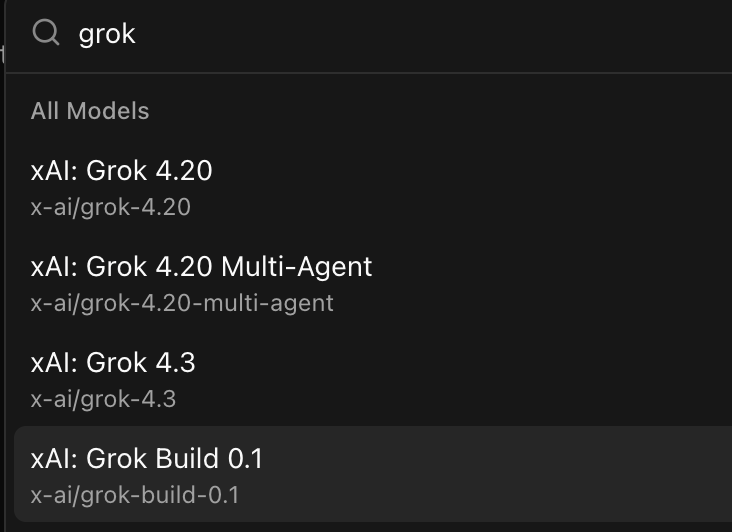
You don’t have to wait to try this out. Grok Build 0.1 is already live and available wherever you use Kilo.
It’s climbing the Kilo leaderboard as developers test its massive context window against older flagship models. Because it is in early access, now is the perfect time to plug it into your Kilo environment and take advantage of no output limits to see how much of a codebase it can successfully rewrite in one prompt.
When you see a $6.4 billion burn rate on an IPO filing, you expect massive swings, and xAI is definitely swinging. (We should note that OpenAI, who also started the IPO process, is projected to spend $115 billion over the next four years — and recent Grok releases do feel like rising GPT competitors).
With this new model, xAI isn’t trying to build the smartest conversationalist. Instead, they are trying to build the most relentless, cost-effective robotic software engineer for both front-end and back-end tasks.
Give Grok Build 0.1 a spin in Kilo today and let us know your thoughts!
I used to switch models depending on what task I was doing to control costs and use the correct model for the correct task but since Kilo AI introduced the Auto balanced and Auto frontier model selection types I just leave them on that. This is probably the wrong post to be commenting on this but does anyone have any information on what models are selected and would I be better off manually selecting a model or just being lazy and leaving on Auto balanced or Auto frontier. I’ve had pretty good success the last few months with using the Auto selections. Thanks.
This model already had the highest accuracy, output format quality, and minimal context drift. While the masses are glazing Cursor, they are sleeping on this model. Maybe this is a good thing, reduced demand, lower costs for value, higher throughput relative to similar token tier competition. Next evolutionary stage, let's see where it takes us.