

Once again, the rumor mill got it wrong. If you’ve been glued to X and Reddit expecting a “Sonnet 5” drop this week, you might be feeling a twinge of disappointment. Don’t be.
Anthropic just dropped Sonnet 4.6, and while the version number looks like an incremental bump, the performance feels like a major leap forward.
At Kilo, we see the usage stats. We know that despite the price tag, Opus and Sonnet remain the undisputed heavyweights for our users. You aren’t optimizing for the cheapest tokens; you’re optimizing for code that actually compiles, agents that don’t get stuck in loops, and PRs that pass review on the first try.
You’re optimizing for models that fit your vision and—you know its true—your agentic lifestyle.
Sonnet 4.6 is the new daily driver for that workflow in Kilo Code. It is arguably the smartest, most effective “workhorse” model we’ve ever integrated. Here’s what you need to know to get the most out of it in Kilo.
The Headline: Frontier Performance, Sonnet Speed
Anthropic calls Sonnet 4.6 their “most capable Sonnet-class model yet,” but that marketing speak undersells it. In our early testing, this model is showing frontier performance across the board—specifically in coding, agentic workflows, and complex project management.
Sonnet 4.6 hit an impressive 74.7% for the BrowseComp benchmark and 79.6%—close to Opus 4.6’s leading 80.9%—for SWE-bench Verified. In other words, it’s here to power any agentic flows you throw at it.
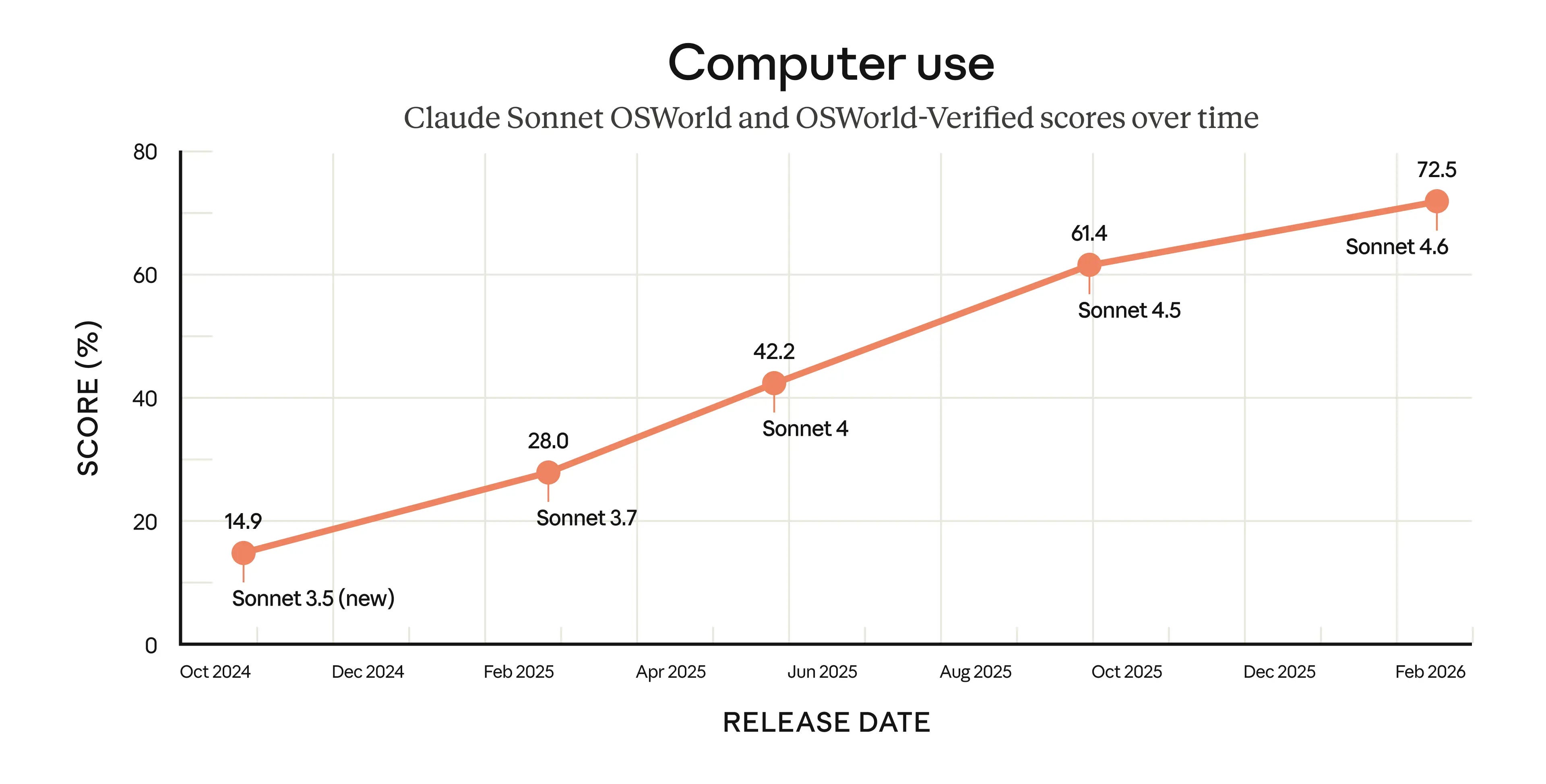
This isn’t just about writing a Python function; it’s about iterative development. Sonnet 4.6 excels at navigating complex codebases, managing end-to-end projects with memory, and handling confident computer use for things like Web QA and workflow automation.
Opus 4.6 and Sonnet 4.5 have already been making a splash with the introduction of Kilo: Auto mode, and we’ll soon be adding Sonnet 4.6 there as well.
The New Knobs: Effort and Thinking
This might also be the closest to an Opus-type improvement that we’ve had from a new Sonnet model.
Just like with Opus 4.6 (released just a couple of weeks ago), with Sonnet 4.6 we’re getting granular control over how the model applies its intelligence. If you are used to just hitting “generate,” you’ll want to pay attention to these changes to get your money’s worth.
Sonnet 4.6 offers strong performance at any thinking effort, even with extended thinking off, and it introduces three distinct “thinking” modes. This is where the magic happens:
Thinking Disabled: The classic experience. Fast and direct.
Extended Thinking: The model takes its time to reason through the problem before outputting code.
Adaptive Thinking: A middle ground that adjusts based on query complexity.
For most heavy coding tasks in Kilo, we are seeing the best results with Extended Thinking at “Medium” Effort. The reasoning capability here is startlingly good at catching edge cases before writing a single line of code. We’re finding that it’s even working with interleaved thinking in the Kilo CLI.
However, if you are migrating existing prompts or workflows from Sonnet 4.5 and want “it just works” reliability, Thinking Disabled is your safest bet. It mimics the 4.5 behavior but with the 4.6 intelligence upgrade.
1M Token Context (Beta)
This is the big one for enterprise codebases. Sonnet 4.6 supports a 1M context window in beta.
If you’ve ever hit the context limit while trying to feed a massive documentation file into your prompt, this is your fix.
Feature Rollout: Now GA
Alongside the model, several critical API features have moved to General Availability (GA). These are native to the Kilo experience:
Code Execution & Web Fetch: The agent can run code and browse the web more reliably.
Tool Search & Programmatic Tool Calling: This makes Kilo’s agentic capabilities significantly snappier.
Memory: Better retention of project details across chat turns, sessions and modes.
The Verdict
Opus and Sonnet have always been the “premium” choice at Kilo, but they justify that cost by being several times more powerful than the budget models. With 4.6, Anthropic has made the efficiency gains necessary to keep Sonnet as the default choice for serious engineering.
Sonnet 4.6 is already available in Kilo. Go break some code (and let Sonnet fix it in Code Reviewer).
Indeed, Claude in any version is my favorite model.