

MiniMax just released their latest model. We’re thrilled to announce that MiniMax M2.1 is available now in Kilo — give it a spin today!
MiniMax’s previous model, M2, has been trending at number 3 on our AI coding models leaderboard in Code mode, so it will be especially interesting to see how M2.1 does in comparison.
The pace of open-source AI these days is just amazing. MiniMax has become a global contender for fast, powerful and efficient AI models, and they continue to support open-source development by releasing model weights on Hugging Face.
But it’s not just about excelling in that playing field.
M2.1 puts MiniMax ahead of DeepSeek and Kimi on several benchmarks, and even catching up to SOTA models from labs like Anthropic in some areas. On SWE-bench Verified, M2.1 scores 74.0, edging out DeepSeek V3.2 (73.1) and Kimi K2 (71.3).
On the VIBE-Web benchmark, which tests the ability to build functional web apps, M2.1 scored 91.5, outperforming Claude Opus 4.5 and Claude Sonnet 4.5 in some categories. The VIBE-Web benchmark moves beyond text-only benchmarks (like MMLU or GSM8K) to evaluate models in multimodal, interactive web environments. This is particularly important for anybody building for the AI-native web.
M2.1 is Super Fast and Efficient
We love benchmarks, but we also love seeing what actually happens in production. Before rolling out M2.1, our team put it through a gauntlet of real-world implementation tasks to see if the hype matched the reality.
Our devs ran four distinct “daily driver” scenarios:
Creation: Built an Express API with TypeScript for URL shortening from scratch.
Debugging: Fixed 7 planted bugs in a Next.js/React game.
Extension: Added direct user upload features to an existing Go file-serving app.
Documentation: Documented a complex Rust CLI that calculates file checksums.
The verdict? M2.1 crushed all four.
“MiniMax M2.1 feels like a sharper and more intentional version of M2, with noticeable improvements to long-horizon reasoning (successful execution of 1 shot apps), and super fast speed and efficiency.”
— Kilo Team
How to Get MiniMax-M2.1
M2.1 is available to all Kilo Code users. No downloads. No GPU configuration. Just code. And FAST!
Open Kilo.
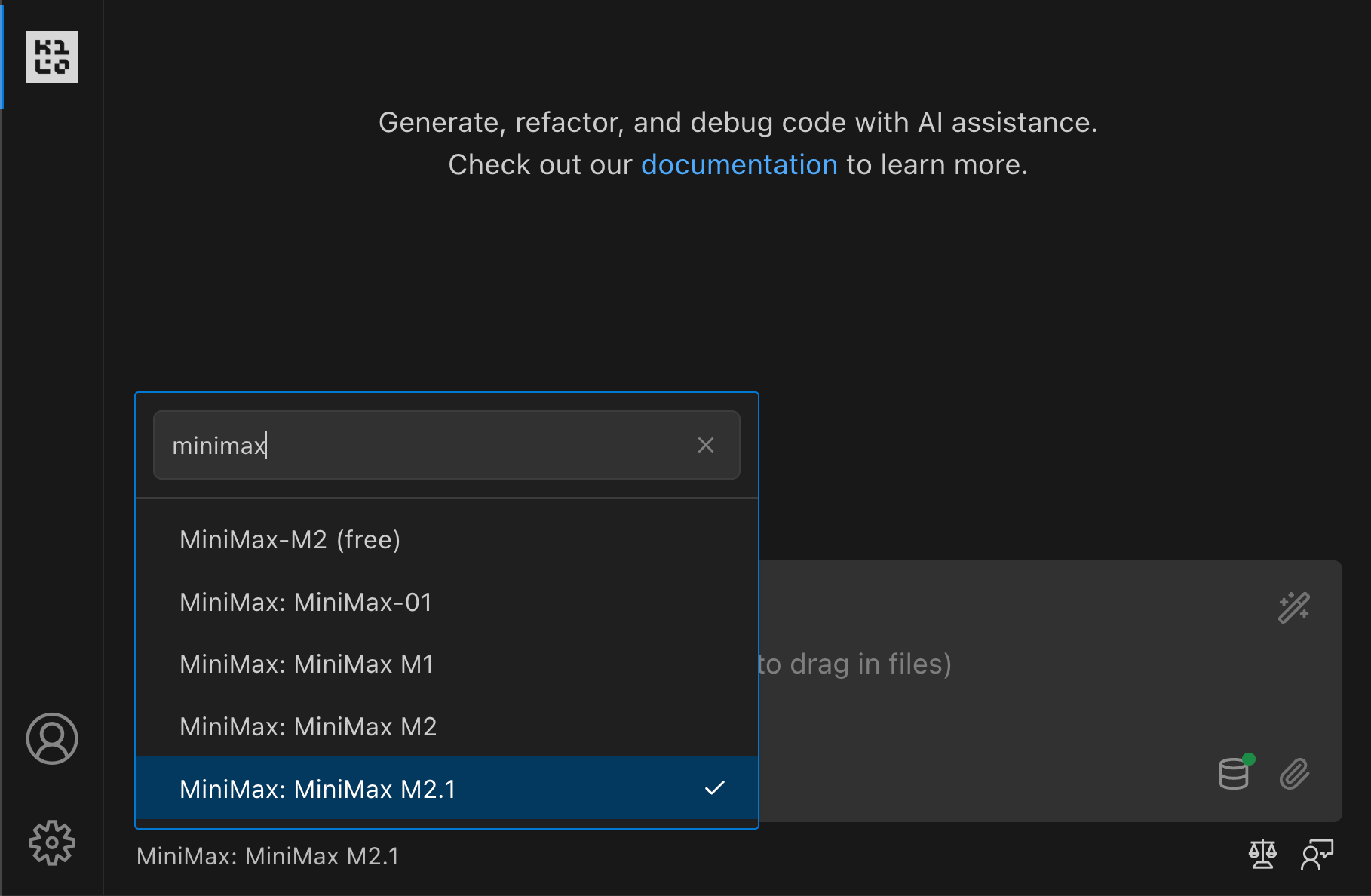
Switch your model to MiniMax M2.1.
Start building.
This is an early release in Kilo. We encourage you to push the model hard—build and deploy an app as fast as possible, throw your toughest Rust documentation or your messiest Next.js bugs at it—the sky’s the limit.
Let us know how M2.1 compares to your current daily driver.
Not sure where to start?
Give Code Reviews a spin. Code Reviews in Kilo Code give you an AI-powered review agent that automatically analyzes your pull requests the moment they’re opened or updated. It reads your diffs, understands your changes in context, and delivers structured feedback—directly in GitHub, as inline comments and summary findings.
You can use MiniMax M2.1 as the reviewing model, to take advantage of its speed and efficiency in a real production setting.