

Meta shipped its first coding agent on August 5. Muse Code installs from the terminal with one command, runs on macOS and Linux, and is powered by Muse Spark 1.2, a new coding-focused model. It plans changes, writes code, validates the result, and coordinates persistent background subagents through long tasks. It keeps an append-only local event log so it can resume exactly where it stopped after a crash.
The interesting part isn’t the agent. It’s the price list, which isn’t in the announcement.
Read the two prices before you read the benchmarks
Meta’s launch post covers background agents, the runtime, bundled skills, Terminal-Bench 2.1 and DeepSWE scores, and a case study where the model spent 24 hours and 1,000+ tool calls optimising GPU kernels. It’s a good post. It contains no pricing.
The pricing lives on the Muse Code product page, and it has two tiers for the same model:
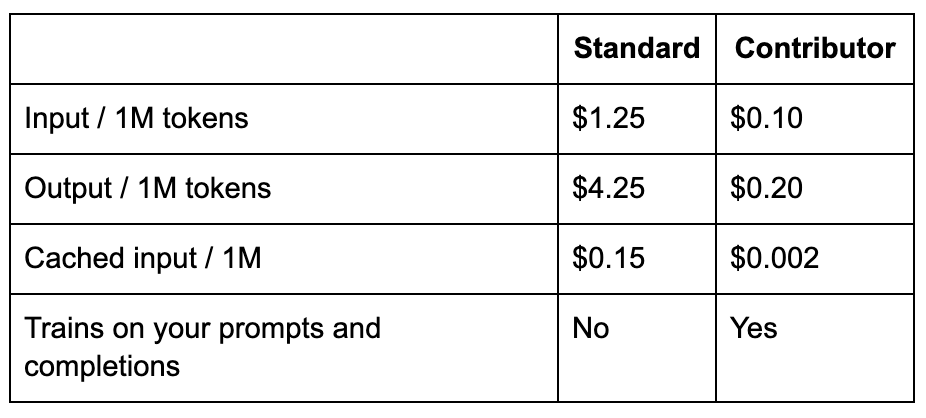
That’s 12.5x cheaper on input and 21.25x cheaper on output. Meta didn’t discount the model. It put a price on your repository and paid in compute. Alexandr Wang, who runs Meta Superintelligence Labs, described it to CNBC as a contributor tier that gets you in more than ten times cheaper than pay-as-you-go.
The cheap tier is also the throttled tier, rate-limited well below Standard. So you pay for the discount twice, once in data and once in throughput.
In the same interview, Wang said Meta is starting to accept zero-data-retention requests, and called it an important enterprise feature. That’s the same option OpenAI and Anthropic already offer in enterprise agreements. So the ladder is: pay full price and Meta won’t train on you, ask nicely and Meta won’t retain you, or pay a tenth and hand over the transcript.
Why code is the data Meta actually needs
Meta’s Q2 2026 results put Family of Apps ad revenue at $59.4B out of $60.8B total. Round it however you like: this is an advertising company. That business was built by learning what people do and selling access to the prediction. The instinct behind the contributor tier isn’t new.
Coding data is the most valuable training data left, because it grades itself. A model that scrapes a blog post learns what confident writing looks like. A model that watches an agent work in a real repo learns whether the change compiled, whether the tests passed, and whether the human accepted the diff. Every contributor-tier session is a problem, an attempt, and a verdict, generated by someone doing real work under real constraints. You can’t scrape that.
There’s nothing shady about the offer. It’s disclosed, it’s opt-in, it’s a payment method on file and a checkbox. That’s the part worth sitting with. The trade is now explicit enough to have a price, and the price is public: your prompts and completions are worth about $1.15 per million input tokens to Meta.
Your call whether that’s a good deal. It’s a much easier call for a weekend side project than for a repo with a customer’s data model in it.
We turned the trade into a game
Telling people their work data has a market price is abstract. So we built the smallest possible version of the argument.
We gave Muse Spark 1.2 one prompt and asked it to build a browser game. The premise: you’re the developer, your repo is the currency, and each round the model shows you three ads generated from what it just read about your work, predicts which one you’ll click, and you try to pick a different one. You’re trying to be unpredictable. You mostly aren’t.
We ran it in Kilo Code, with the model routed through Kilo Gateway at cost. That’s our own product, so treat the demo as a demonstration rather than a benchmark.
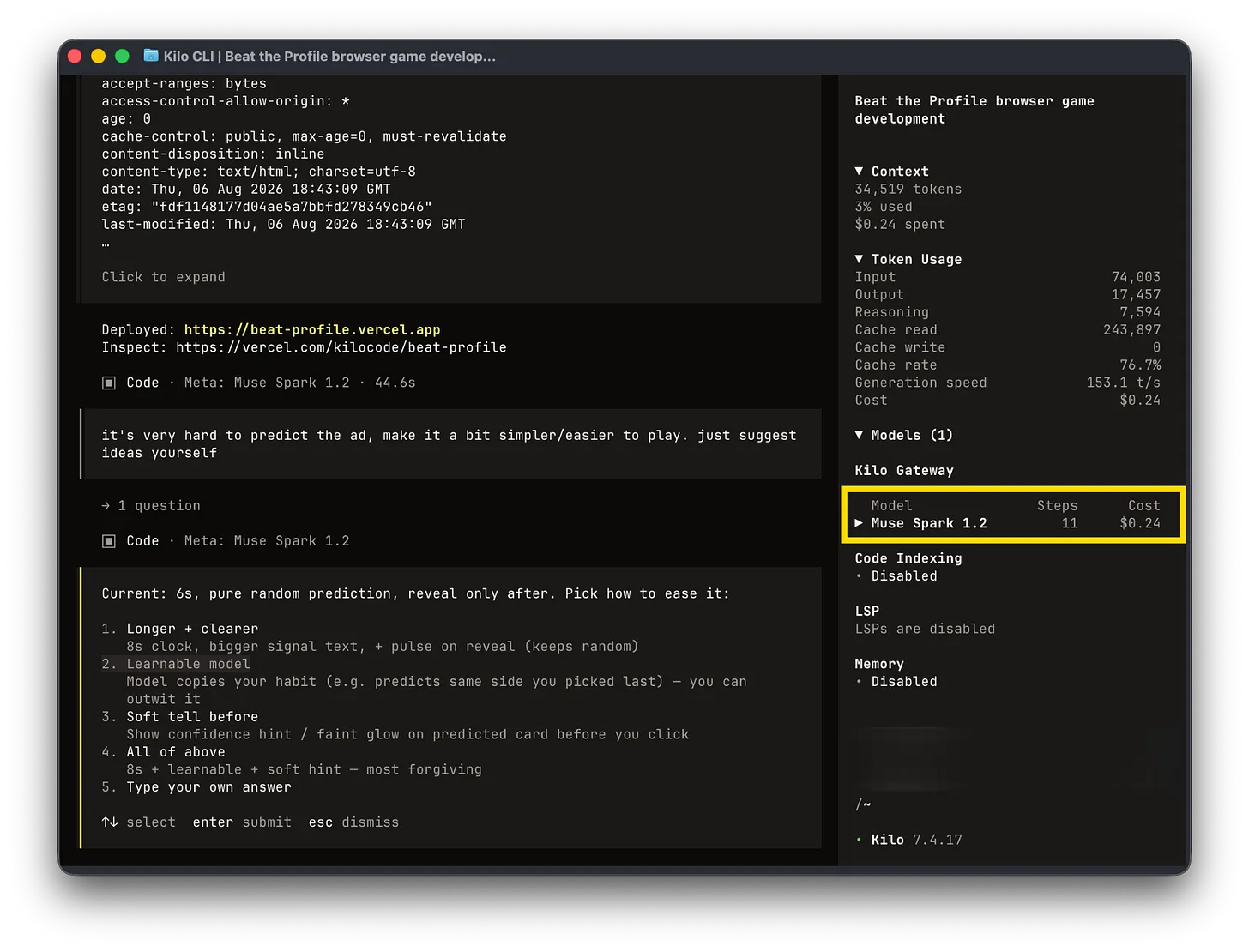
It didn’t land in one shot. The first response ran, but we had to fix a few small things to get it playable. We’re leaving that in because a clean one-shot would be the less useful result. Muse Spark 1.2 got a working game most of the way there from a single prompt, and the gap between “runs” and “playable” was small enough to close in minutes. We spent only $0.24.
Three things we’ll be straight about. The ads are an analogy: Meta hasn’t said anything about using developer prompts for ad targeting and we’re not claiming it does. Ad targeting is just where most of us first learned to recognise a data-for-price trade, so it’s the fastest way to make this one legible. Second, we routed at Meta’s Standard rate, the tier where Meta says it doesn’t train on prompts and completions, so nothing we typed here paid for itself in data. Third, we picked the model for this on purpose and then paid full price for it, which is the entire point of the next section.
Distribution wins, so the terms travel with it
Meta isn’t trying to have the best coding model. Wang said as much: the positioning is price, not capability. And price at a 20x gap is a distribution strategy. It’s the same play that got Chinese open-weight models into everyone’s rotation, run in reverse, with the discount funded by training rights instead of by lower serving costs.
That’s why the terms matter more than the benchmark. Whichever agent gets cheap enough to be the default is the one whose data policy becomes your data policy, and most teams will never read it. The contributor tier at $0.10 in / $0.20 out will end up in a lot of .env files by Friday, chosen by whoever was told to keep the AI bill down.
The counterweight isn’t outrage. It’s being able to make the model choice and the data choice separately.
That’s the whole reason Kilo works the way it does. Kilo Gateway gives you 500+ models at cost, frontier or open weight, or you bring your own keys and the traffic bills directly to the provider. Muse Spark 1.2 is in there, at Meta’s Standard rate, which is how we built the game. One agent across VS Code, JetBrains, the CLI, and cloud agents. Fully open source, so the data path is something you can read instead of something you have to trust. If a model’s terms are wrong for the repo you’re in, you switch the model, not the workflow. And if the answer for a given codebase is a local open-weight model with nothing leaving the machine, that’s the same interface too.
Use Muse Spark 1.2. It looks good, and cheap frontier-class models are good for everyone. Just make the tier a governance decision with your name on it, not a line item someone optimised while you were on holiday.
Sources
Primary:
Meta Superintelligence Labs, Introducing Muse Code and Muse Spark 1.2, August 5, 2026
Meta, Muse Code product page (pricing and tier terms)
Meta, Meta Model API
Meta Platforms, Q2 2026 earnings press release (SEC Exhibit 99.1) and Q2 2026 earnings call transcript
OpenRouter, Muse Spark 1.2 model page and Meta model index
Reporting, for the Wang quotes:
CNBC, Meta debuts Muse Code to take on Anthropic and OpenAI, August 5, 2026
I keep seeing Indian dev shops jump at the cheap tier for cost-cutting.
But for anyone touching client codebases—especially US/EU clients—the data risk is a compliance and reputational liability. The $0.10/0.20 tier is a loss leader; the real cost is your prompts.
My rule for clients: cheap tier only for non-sensitive code; treat Standard as a business expense worth budgeting.