

Autocomplete has been sidelined as a feature.
Microsoft quietly killed IntelliCode a few days ago. People are constantly complaining about code completions getting worse across IDEs.
What’s the reason for all of this? It comes down to 1 buzzword: prompting.
Everyone is telling us: Prompt, don’t code
There’s a growing narrative that the future of coding is pure prompting. You describe what you want, the code appears, and you review it. No writing. No typing. No autocomplete needed.
Just go to the home page of VS Code to see what I mean. You’ll see a bunch of chat boxes, prompts, code-gen examples, etc.
This approach has its time and place. After all, Kilo’s core product is Kilo Code which does exactly that (you enter a prompt, you get some code back). However, many companies are pushing this approach way too far, without taking into consideration what (we) developers really want and need: Prompting AND Autocomplete
Meanwhile, AI-powered autocomplete has emerged as something with real use-cases that go beyond auto-completing keywords.
People are starting to use autocomplete for more than “filling in obvious lines”
A few days ago, I published a post where we analyzed 147 survey responses from a survey we ran about Kilo autocomplete.
It turns out that AI-supercharged autocomplete is inspiring software developers to use this feature for way more than ‘filling it obvious lines’. They write tests, docs, and even entire SQL queries.
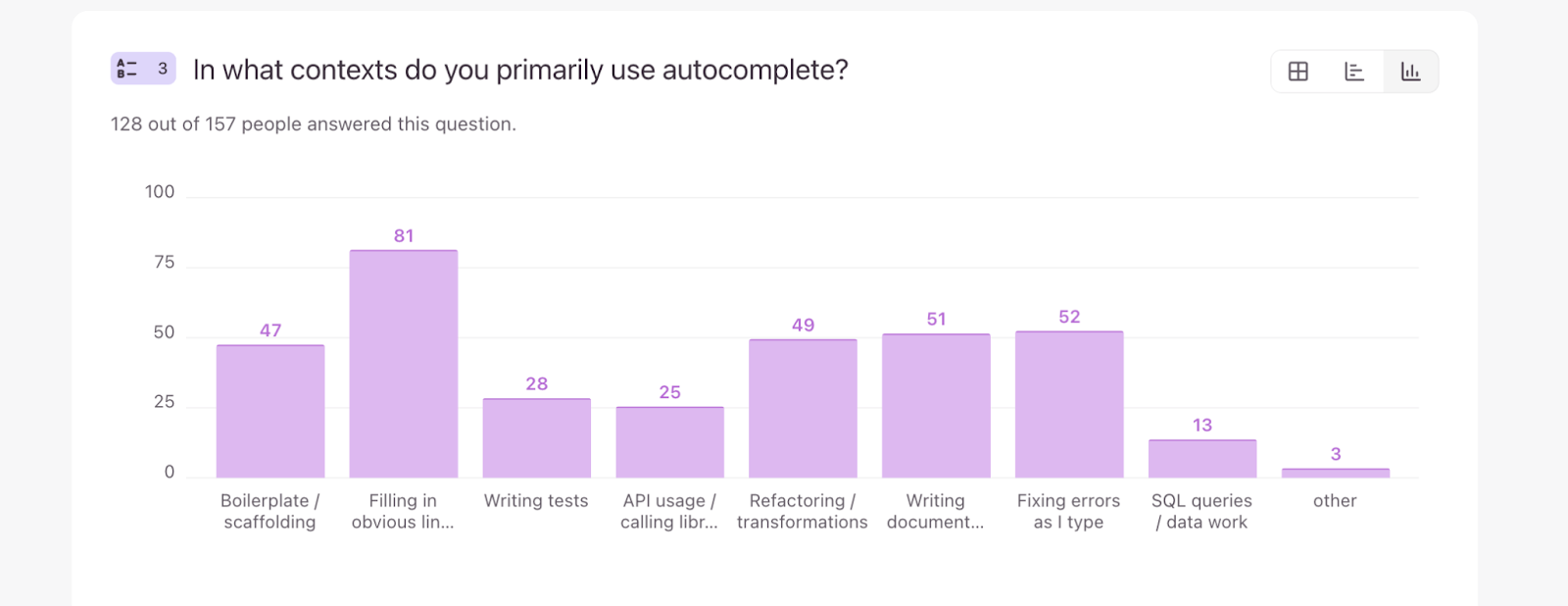
AI has supercharged autocomplete to do WAY more than simple inline completions; it can suggest entire blocks of code based on surrounding context, etc.
Let’s dive deeper.
Autocomplete is no longer prompting’s little brother
Smart use of AI has turned autocomplete into more than a keystroke saver. A few weeks ago, Nathan did a video comparing Cursor’s autocomplete, Copilot, and Kilo Code.
While Copilot is still in the ‘let me do as little as possible so you think I’m a pre-AI autocomplete feature’ model, Cursor and Kilo take your whole context (files, surrounding lines, etc.) into consideration and help you prefill entire lines or blocks of code.

You could view this as good or bad, but the fact remains that AI-supercharged autocomplete is becoming a viable option for developers who want a more hands-on approach to using AI to code, especially senior software developers.
Let’s not let proprietary tools define autocomplete
A year ago, Cursor acquired Supermaven, which (along with Cursor’s data) made Cursor’s autocomplete one of the best in the industry.
The downside is that you have to switch IDEs. And well, Cursor is proprietary. Copilot (its autocomplete part) is also closed-source.
By contrast, Kilo Autocomplete works directly in VS Code and JetBrains. And it’s fully open source (we forked Continue’s autocomplete and improved on it).
We’re now taking concrete steps to continue building the best open-source AI autocomplete in the world, together.
Let’s build the best open-source autocomplete in the world, together
If you want to help, there are three ways:
Join our Discord (the #autocomplete-feedback) channel. I’ll make sure to respond to every question/comment you have.
Want to help us make our autocomplete better? We’re looking for contributors (at the moment we’re also providing monetary rewards or Kilo credits for every meaningful contribution). Fill out this form and we’ll get in touch.
Do you use autocomplete often? We’d love to interview you for 30 minutes (typically via Google Meet/Zoom). We’ll provide $100 in Kilo credits for people we interview. Fill out this form if you want to be interviewed.