

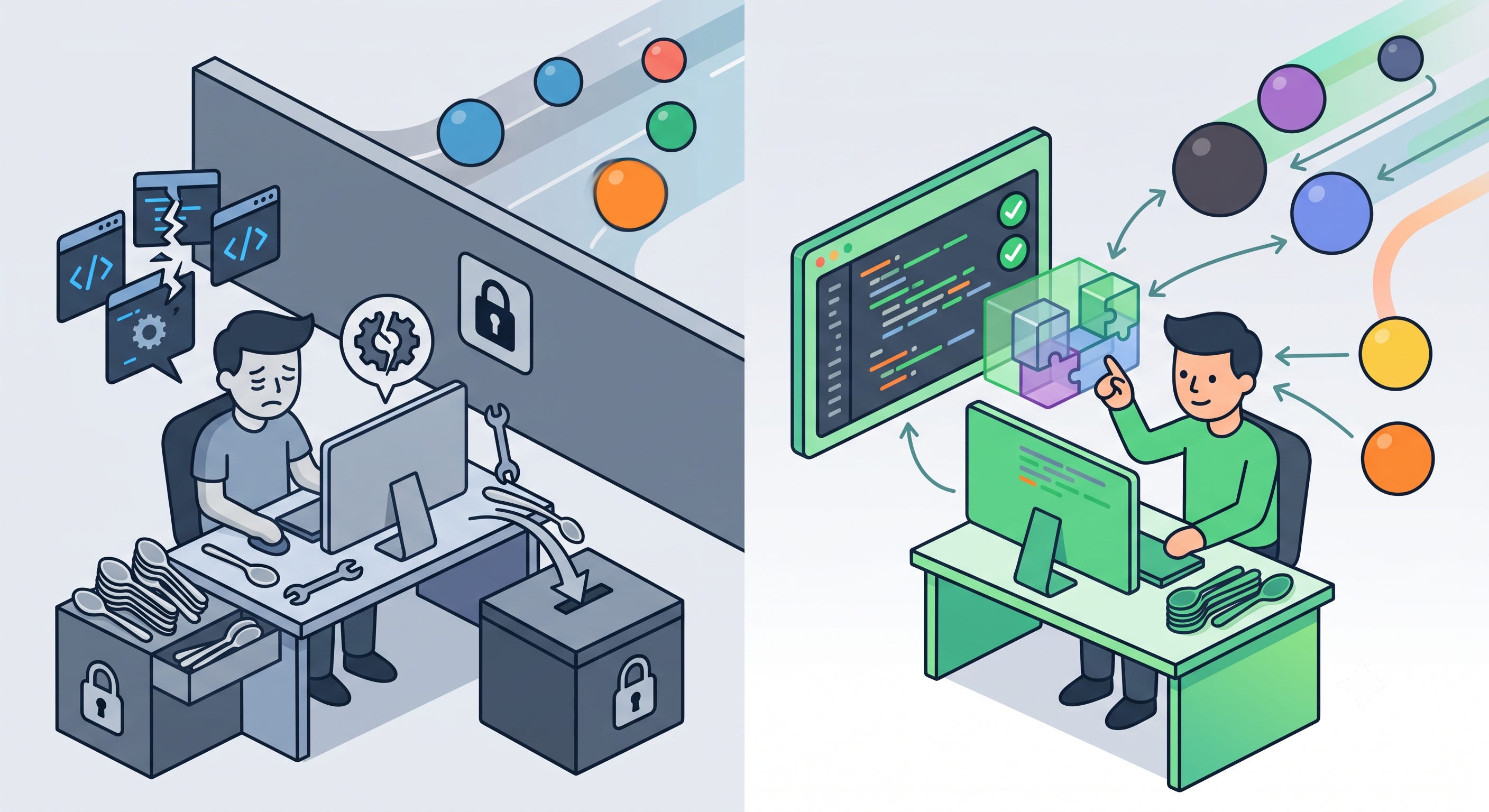
Spoon theory is a way of describing a limited daily budget of energy, coined by people managing chronic illness to explain why a task that looks small can still cost everything they have left. Developer tooling doesn’t usually get discussed in those terms, but it should. A broken environment. A silent failure. An hour lost to a tool that won’t say why it did what it did. All of that is spoons, spent on the tool instead of the problem, and newcomers and solo maintainers feel it first because they don’t have a platform team to absorb the hit.
The tax nobody puts a name on
AI coding agents are supposed to give some of that budget back, and often they do. An agent that plans, writes, and iterates on a feature with you saves real effort. The problem shows up when you commit to the wrong one and a familiar pattern comes back around: your prompts and your team’s workflow habits end up locked inside one vendor’s product, priced on their terms, running whatever model they picked for you this quarter.
When that agent breaks, you usually can’t see why. You wait on support, or you route around it and lose the work anyway. It’s friction with better branding, and it costs a team the way any stubborn tool does. Someone loses an afternoon debugging the tool instead of the problem. They write up a workaround. The next new hire has to relearn that workaround before getting to real work, and the cost keeps spreading outward from whoever hit it first.
The ground is moving faster than lock-in can track
The timing makes this worse than it would have been a year ago. The model market is moving faster than any single vendor relationship can keep up with.
Moonshot AI open-sourced the full weights of Kimi K3 in late July: a 2.8-trillion-parameter model, and the largest open-weight release so far. DeepSeek V4 reached general availability the same week, under an MIT license. Qwen’s 3.8-Max shipped days after that. The UK’s AI Safety Institute now measures the best open-weight models at four to seven months behind closed frontier labs on hard benchmarks (down from six to ten months for most of last year), while running at a fraction of the cost. Chinese open-weight providers alone now account for something like 45% of tokens flowing through major routing platforms, up from under 2% a year earlier.
That pace is exactly why lock-in costs more now than it used to. A coding agent that hard-codes a team to one vendor’s model puts “which model is best” on that vendor’s release calendar instead of the market’s. Two months from now, a cheaper or better option ships somewhere, and a locked-in team doesn’t get to use it until their vendor decides to offer it, or until the team rebuilds the workflow to switch. That cost lands hardest on teams with the least room to absorb it: the ones who can’t just pay for the expensive tier and move on.
What changes with an open agent
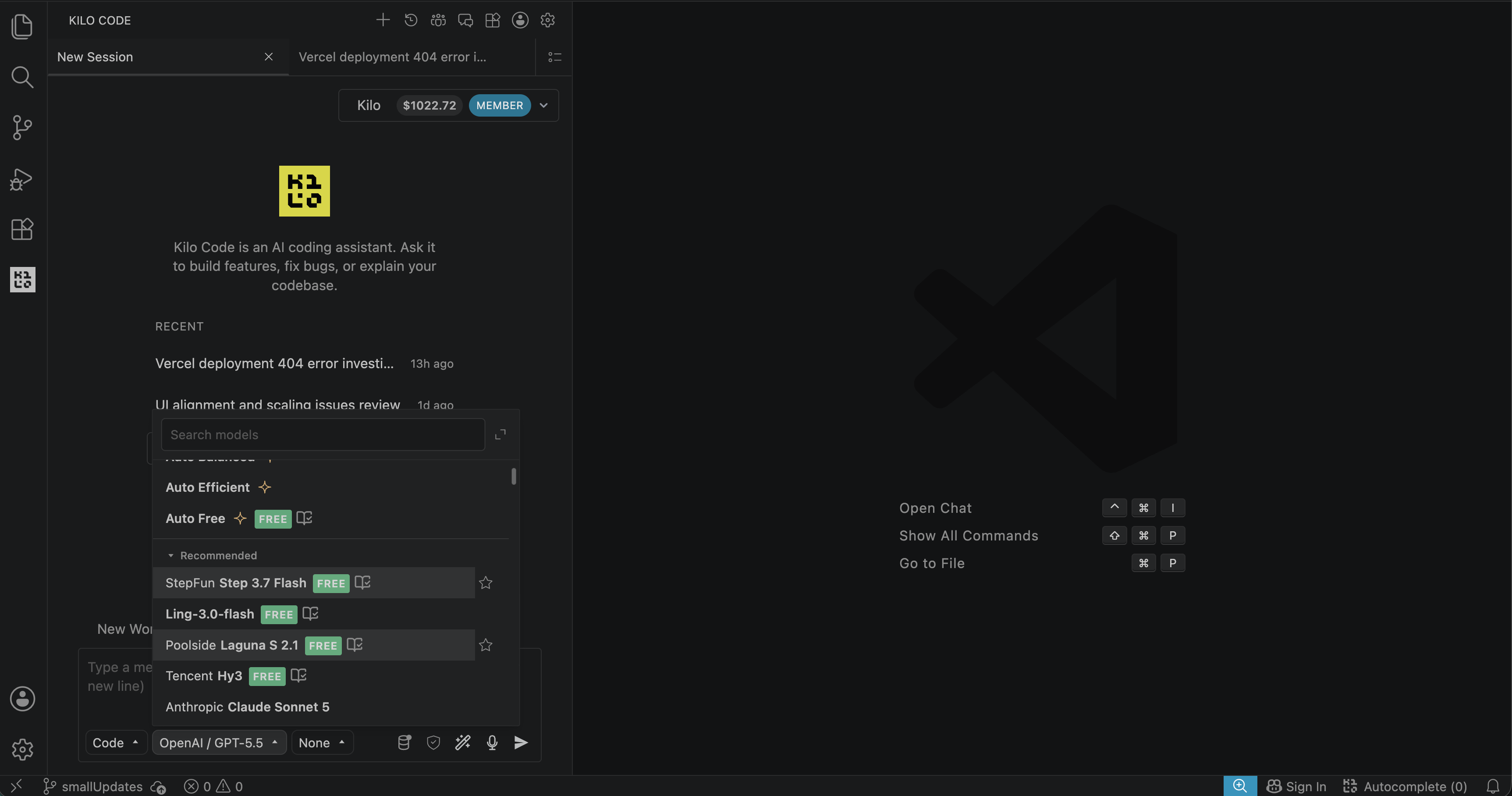
This is the case for an agent that doesn’t force the tradeoff in the first place. If the prompts and context handling are open source, a team can actually look at what happened when something breaks, instead of filing a ticket and waiting on an answer. Switching models can mean picking a different setting: bring your own API keys, run something locally, or let a router pick between options. That’s why a team can turn on the next Kimi K3 or DeepSeek V4 release without rebuilding anything to use it. And if the agent works the same way in the IDE, the terminal, and the cloud, the context a team has built up doesn’t reset every time someone’s setup changes, which matters most for whoever on the team has the least experience to fall back on.
Kilo Code is built this way: open source under Apache-2.0 for the extension and MIT for the CLI, running in VS Code, JetBrains, the CLI, and the cloud, connected to more than 500 models with zero markup on inference. It has grown past 3 million developers and 40 trillion tokens processed. That growth says something about usefulness. The portability and the transparency were part of the design from the start.
Build for the tax that’s actually there
That early design choice matters more this year than it would have a year ago, simply because the model market keeps moving. A team on an open agent is more prepared to adjust to pace of the frontier. A team locked into one vendor’s model has to wait for permission, or rebuild. Multiply that gap across a team, and it’s the same tax spoon theory describes: energy spent fighting the tool, paid first by whoever on the team has the least of it to spare.
This 'spoon tax' mirrors what I see in Indian tech clients' finances—subscription creep and vendor lock-in are just endowment plans with better branding.
I keep noticing engineers who budget for SIPs but not for tooling costs, then wonder why their effective savings rate shrinks. Same pattern as high-expense mutual funds: the drag compounds quietly.
Open-source agents are the index funds of this space—lower friction, more flexibility, no surrender charges. Budget for tooling as a recurring