

Last week, someone in the Kilo Discord asked: “Should I switch from OpenClaw to Hermes?” I’ve seen this question pop up a dozen times since Hermes launched in February. It’s the right question to ask — both are open source, both connect to your chat apps, both run tools and remember things. On paper, they look almost identical.
But after running both for the past two months, I think the feature checklists are a distraction — the design philosophies are where they actually diverge.
The One-Sentence Difference
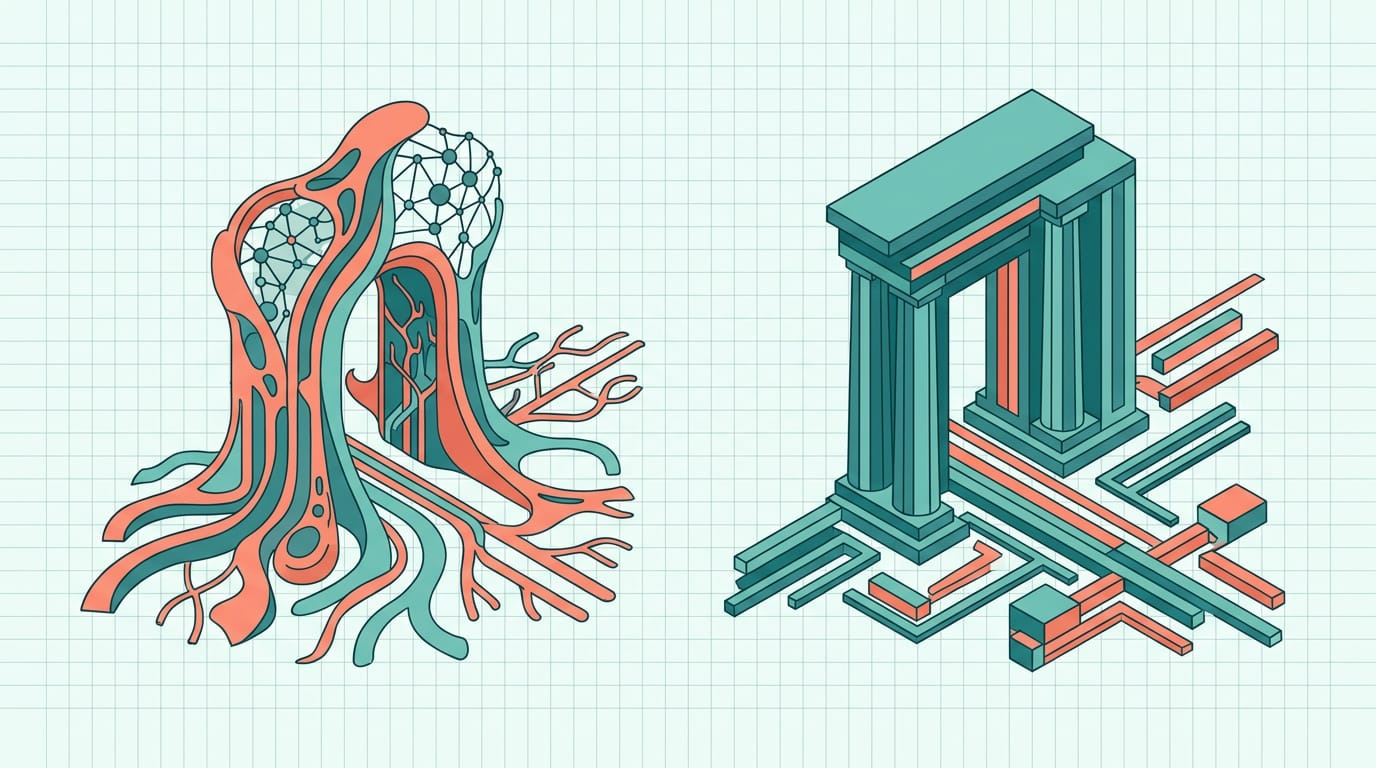
Hermes packages a gateway around a learning agent.
OpenClaw packages an agent around a messaging gateway.
That distinction sounds abstract, but it has practical consequences for how you configure and interact with each tool.
What Hermes Gets Right
Hermes Agent comes from Nous Research and launched in February 2026. It’s hit about 135,000 GitHub stars as of this writing. The headline feature is what they call a “learning loop” — the agent creates and evolves its own skills based on what it does.
From their feature docs:
Self-improving skills: The agent generates procedural knowledge from experience. Run the same task type a hundred times, and Hermes actually gets better at it.
Five sandbox backends: Local execution, Docker, SSH, Singularity, and Modal. You pick how isolated you want command execution to be.
Subagent delegation: Spawn child agents with isolated contexts and terminals. Parallel workstreams without context pollution.
Broader browser/voice stack: Browserbase, Browser Use, Firecrawl, local Chrome, plus native voice in Discord channels.
The Hermes documentation is worth reading even if you don’t use it — the provider matrix alone covers 19+ providers with detailed auth flows.
What impressed me most was the checkpoint system. Before Hermes touches files, it snapshots your working directory. /rollback if something goes wrong. I’ve used this more times than I’d like to admit.
What OpenClaw Gets Right
OpenClaw has been around longer and has the larger community — roughly 369,000 GitHub stars and 13,700+ community-built skills. It started as a personal assistant project by Peter Steinberger and grew into something much bigger.
OpenClaw is fundamentally a gateway. The docs are explicit: “The Gateway is the single source of truth for sessions, routing, and channel connections.”
What that means in practice:
Channel breadth: Discord, Google Chat, iMessage, Matrix, Microsoft Teams, Signal, Slack, Telegram, WhatsApp, Zalo, WebChat. One Gateway process handles all of them.
Multi-agent routing: Isolated sessions per agent, workspace, or sender. You can run different agents for different purposes through the same gateway.
Mobile nodes: iOS and Android apps that pair with the gateway for camera, canvas, and device actions.
Massive skill ecosystem: 13,700+ community skills covering everything from email to calendar to flight check-ins.
The architecture assumes you want one always-on process that routes messages to agents. That’s different from Hermes’s model of “here’s an agent runtime that can talk to various platforms.”
Known Pitfalls
Both tools have well-documented failure modes that the communities are vocal about. Worth knowing before you commit.
Hermes:
Self-evaluation always passes. Hermes evaluates its own work to decide if a task succeeded. The problem: it almost always thinks it did well, even when it didn’t. This means the skills it auto-generates from “successful” tasks can encode errors. You need external validation for anything important.
Self-learning overwrites manual edits. The same system that auto-generates skills also overwrites your customizations. If you’ve spent time tuning a skill for a specific workflow, the agent may “self-improve” it back into something generic. Power users find this maddening.
Maturity gap. With only 11 releases compared to OpenClaw’s 137, Hermes simply hasn’t been tested at the same scale. Fewer updates means fewer chances to break things — but that’s not the same as proven stability.
OpenClaw:
Updates break things. This is the most consistent complaint in the community. Users report roughly a 25% chance that any given update will break response delivery, cron jobs, or webhooks. The development process lacks the staging/testing discipline you’d expect.
Memory is unreliable. Agents forget instructions, cross-contaminate data between projects, and repeat mistakes. Memory retention issues are the #1 driver of user churn.
Self-hosting is the real barrier. Docker setup, SSH configuration, YAML files, security hardening, 24/7 uptime — users consistently report spending more time on infrastructure than on their actual agent workflows.
Trade-offs
A comparison on ScreenshotOne put it well: Hermes is “agent-first” while OpenClaw is “gateway-first.”
Hermes optimizes for the agent becoming more capable over time. It’s built for people who want autonomous agents that learn from experience.
OpenClaw optimizes for a persistent assistant you can message from anywhere. It’s built for people who want infrastructure they can talk to.
Neither approach is wrong. But they lead to different outcomes:

Security Considerations
This matters more than people think. A Reddit thread documented OpenClaw’s 2026 security incidents: 6 CVEs, 341+ malicious skills identified in the community repository, 135,000+ exposed instances found by Shodan.
OpenClaw grew fast. Some security assumptions that made sense for a personal tool on a laptop became dangerous when people started running it on public VPSes with open ports.
Hermes, being newer, has zero reported agent-specific CVEs as of April 2026. That’s not because it’s inherently more secure — it just hasn’t had the same scale of exposure. Give it time.
Both projects now have sandboxing options and approval flows. But if you’re deploying either on a server, audit the defaults. Neither assumes you’re running on a hardened production box.
When to Pick Hermes
Hermes is the better choice if:
You want an agent that improves at tasks over time
You need multiple sandbox backends (especially Modal for cloud execution)
You’re doing research-style workflows with subagent delegation
You want tight IDE integration via ACP
You’re willing to trade ecosystem size for a more capable core agent
The learning loop is what justifies choosing Hermes over OpenClaw. If you’re running the same types of tasks repeatedly — data analysis, code review, research synthesis — Hermes will genuinely get better at them.
When to Pick OpenClaw
OpenClaw is the better choice if:
You want to message your assistant from everywhere (24+ platforms)
You need the existing skill ecosystem (13,700+ skills)
You want mobile nodes for phone camera/canvas integration
You’re building team infrastructure, not just a personal agent
You value stability over cutting-edge features
If your primary use case is “I want to message my AI from WhatsApp and have it do things on my computer,” OpenClaw has that nailed.
The Cost Problem
This doesn’t get discussed enough. Running either agent autonomously is expensive if you’re not careful. Every message sends the full conversation history to the API, so costs compound within a session.
Users in the community report anywhere from $1-3/day on budget models to $130+/day on Claude Opus for heavy agentic use. The fix is aggressive session resets and picking appropriate models per task tier:
Quality-sensitive work: Claude Opus 4.6 (expensive, best agentic performance)
Daily driver: GPT 5.4 (thinking mode on medium+) or MiniMax M2.7
Budget automation: Qwen 3.5/3.6 (free on OpenRouter), GLM-5.1, Kimi K2.5
Flat-rate subscriptions (MiniMax at $10-20/month, Ollama Pro Cloud at $20/month) are rapidly replacing per-token billing as the community default.
What I Actually Use
I run both — and the community data confirms this is a growing pattern. The specific architecture that works: OpenClaw as orchestrator (planning, decomposition, multi-step coordination, scheduling) and Hermes as execution specialist (fast, repeatable task loops). They communicate via the ACP protocol.
OpenClaw handles my day-to-day messaging — it’s the interface I talk to from Telegram. I’ve been using it for months and the skill ecosystem covers most of what I need.
Hermes runs on research tasks where I want the learning loop. When I’m doing a series of similar analyses, Hermes’s skill evolution actually matters.
I could probably consolidate — Hermes’s docs actually note that it’s the “successor to OpenClaw” and they have a migration command (hermes claw migrate) — but I haven’t felt the urgency. They solve different problems well.
Summary
Both projects are actively developed. Both have real communities. Both work.
Hermes is younger, more ambitious architecturally, and smaller in ecosystem. OpenClaw is more mature, broader in integrations, and has had more security scrutiny (for better and worse).
The 30% of developers who switched from OpenClaw to Hermes cite “maintenance fatigue” from debugging community skills and wanting the learning loop. The 35% who stayed on OpenClaw cite integrations and ecosystem breadth.
Pick based on what you actually need. If you want a persistent assistant you can message, OpenClaw. If you want an agent that improves itself, Hermes.
Or run both — they’re free, and the resource overhead of a second process is negligible.
Links:
Hermes Agent — official site
OpenClaw — official site
This was a really good article. Thanks for it.
"Hermes packages a gateway around a learning agent.
OpenClaw packages an agent around a messaging gateway."
Many of us have the same question, thanks for the article.