

Dots, Instinct, and Meta’s Muse are all part of the same broad category: always-on agents. They understand what you’re working on, retain context, and take action on your behalf without needing you to direct every step.
OpenClaw helped popularize this category. It showed what an agent could look like when it ran continuously and was accessible through messaging apps people already used. The project started in November 2025, before this latest wave of products.1
The biggest distinction I see between these products is who they’re built for.
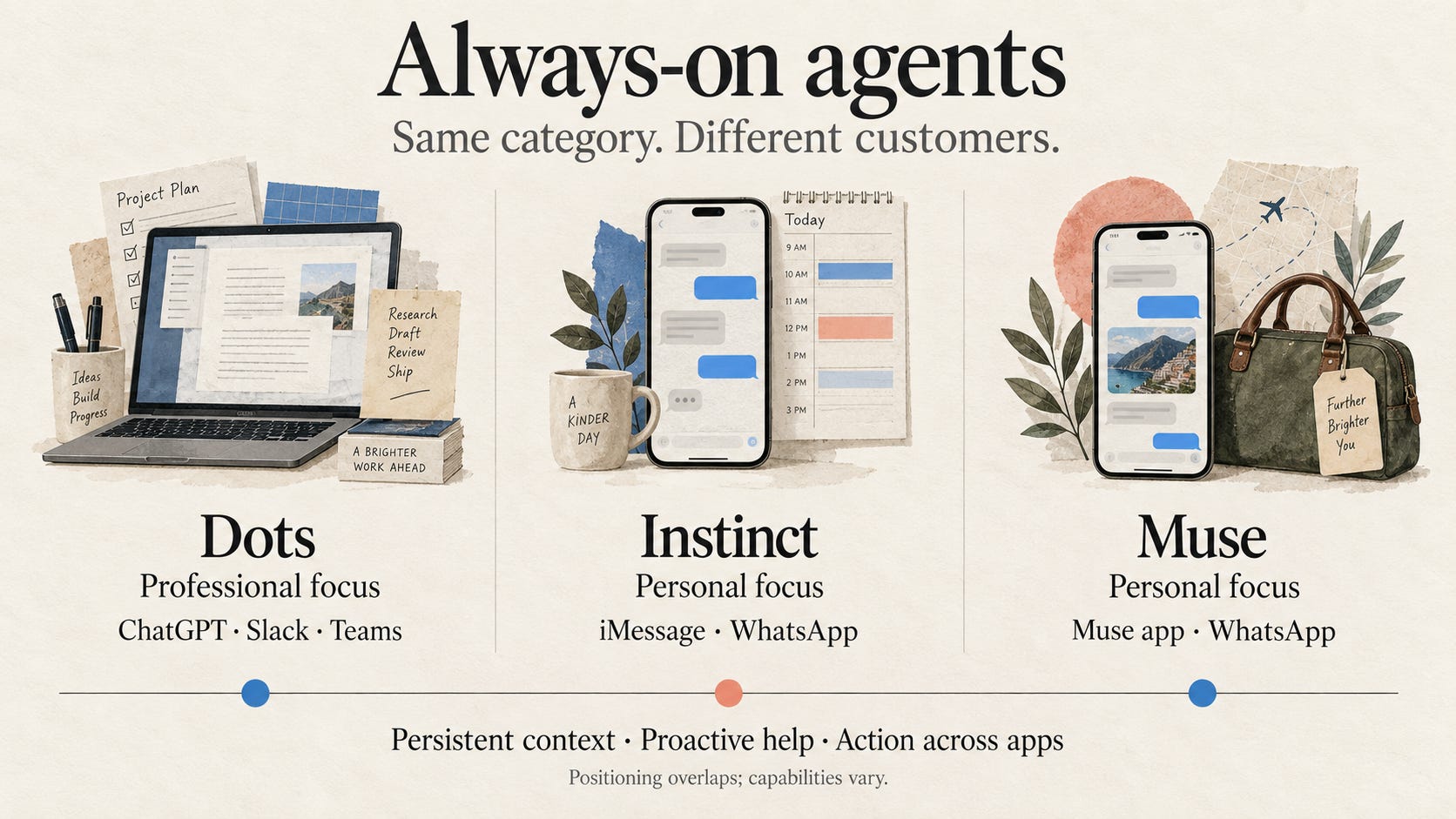
Professional vs. Personal Use Cases
Dots is clearly positioned for professional use cases. You can see that in how OpenAI demoed it: fixing software, updating launch materials, working through research, and preparing sales proposals.
Instinct is built around personal use cases, like booking a ride to the airport, finding a handyman, and following up on conversations you’ve dropped. Meta’s Muse is also positioned as a personal agent.2
This distinction makes sense because it reflects each company’s go-to-market.
OpenAI is building an enterprise business, so it makes sense that its agents are presented as something you can delegate professional work to. Meta is a consumer technology company, so it makes sense that Muse is presented as something that helps with your everyday life. Instinct is building directly around that personal assistant use case.
That’s my interpretation of the positioning. The capabilities overlap. But the examples a company chooses tell you which customer it wants to reach and what it wants that customer to try first.
How You Interact With Each Agent
You also see this distinction in how you interact with each product.
You interact with Dots through ChatGPT, with Slack and Teams available as additional channels. You interact with Instinct through iMessage or WhatsApp. Muse has its own app and is also available through WhatsApp.3
That matters because where an agent lives affects what you think to ask it to do. If it’s in Slack, you’ll probably bring it into work conversations. If it’s in your messages, you can text it when you remember that you need to make an appointment or book something for tomorrow.
For personal use cases, being able to text an agent is a meaningful part of the product. You don’t have to remember to open another app. For professional use cases, being accessible in the tools your team already uses serves a similar purpose.
Credentials, Training, and Advertising Are Different Questions
The other comparison worth making is how these products handle credentials and privacy. An always-on agent needs access to be useful. But giving it access to your accounts raises several different questions.
Can the model see your passwords? Can the company use your information to train models? Can that information be used for advertising?
Those are separate questions, and the answers vary by product.
Dots
OpenAI says supported secure login forms keep your credentials from being exposed to the model. That protection doesn’t apply to passwords you put directly into a chat, document, or plugin.
The training policy depends on your account. Business, Enterprise, and Edu data isn’t used for training by default. On personal plans, your model-improvement setting controls whether eligible conversations and work can be used.
OpenAI also says it doesn’t train directly on proactive background research or the agent’s notes, although information from that research can become eligible if it’s used in a conversation or task.4
Dots is currently offered on ad-free plans. But that is a different statement from an explicit commitment to keep all agent data separate from advertising systems.5
Instinct
Instinct’s privacy policy explicitly anticipates you providing usernames and passwords so it can sign into accounts on your behalf. I didn’t find a comparable public technical explanation of how those credentials are kept separate from the model. That leaves an unanswered question about its implementation.
Instinct allows your information to be used for training, with an opt-out and some safety-review exceptions.
Google Workspace API data gets additional protections: Instinct says it doesn’t use that data for model training or advertising. That’s a specific commitment about Google Workspace data, rather than a blanket commitment covering everything you share with the assistant.6
Muse
Muse is more explicit about its credential architecture. Meta says passwords and authentication tokens are stored separately from the agent, which can use them without seeing the real credentials.
Meta also says Muse conversations and data in its virtual machine aren’t shared with Meta’s advertising systems. There’s a qualification: if Muse visits a retailer’s website or takes action on another service, that activity can still affect the ads you see.
And excluding data from advertising doesn’t mean excluding it from training. Meta says sanitized interaction data is used for training unless you opt out. Its launch architecture also allows Meta to access data when necessary to operate, support, or secure the service.7
These are the companies’ published descriptions and policies. They tell us what each company commits to, but they don’t independently establish how well those protections work.
What I’d Compare Before Choosing One
I think the professional-versus-personal distinction is useful for understanding where this category is going. The technology overlaps, but each company is packaging it around the customers it knows how to reach.
For OpenAI, that means showing how an agent can take on more of your work. For Instinct and Muse, it means showing how an agent can take on more of your personal logistics.
Over time, those use cases will overlap even more. A business trip involves both work and personal planning. Your inbox contains both professional responsibilities and things you need to handle at home.
For now, I’d compare these agents on three things: what they’re built to help you with, how you interact with them, and what happens to the access and information you give them. Those differences matter even when the underlying promise sounds similar.