


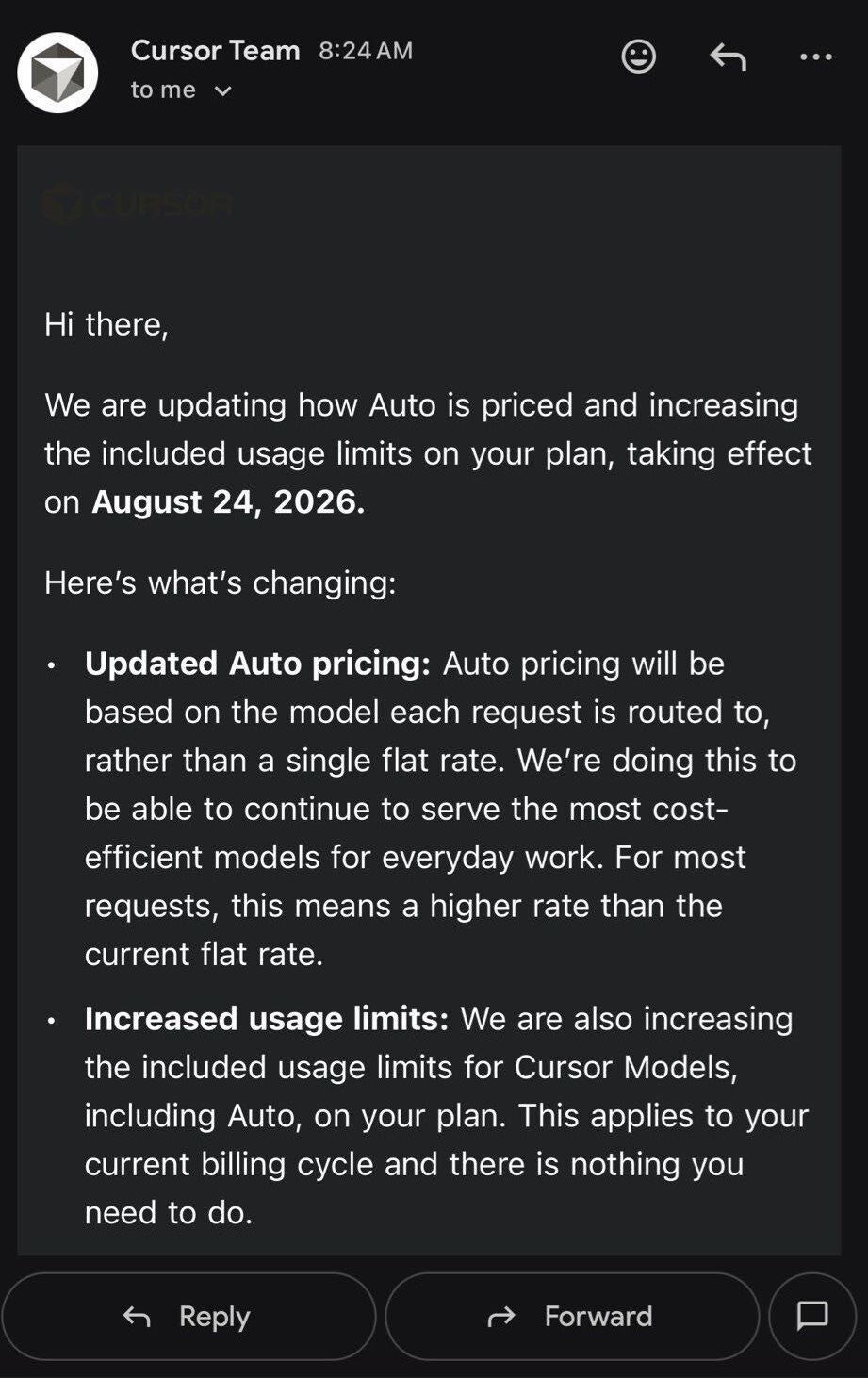
On sourcing: The August 24 change is known only from an email Cursor sent to subscribers. There’s no blog post and no changelog entry, and Cursor’s pricing docs still list Auto Cost as a flat rate. Everything below about Cursor comes from recipients posting the email to r/cursor and to X. Check Settings → Billing after the 24th.
How it started and how it’s going
GitHub Copilot
Unlimited on a base model, then premium requests from June 2025, each model carrying a multiplier so one request could cost fifty times another. Then token billing on June 1, 2026, drawn on input, output and cached tokens at API rates. Annual plans are being retired.
Anthropic
Doesn’t reprice, restricts instead. Subscriptions get rate limits instead of higher rates: weekly caps arrived on Claude Code in August 2025. Enterprise gets no such cushion. It’s seat price plus usage at API rates, metered from the first token.
Cursor
Has repriced repeatedly, and this week’s email is the latest. Included usage for Cursor Models goes up. Auto stops being a flat rate. Cursor’s own wording is that most requests will draw at a higher rate than they do today.
Enterprises hit this first
Procurement runs on annual cycles. Pricing models now change quarterly. Copilot retiring annual plans is that collision made literal: the contract term outlived the pricing model it was signed under. A budget approved in Q1 2026 under premium-request maths was obsolete by June.
Five questions worth asking now
Not “are you ready for metered pricing.” Everyone is metered already (to some degree). The question is what it costs to leave.
Can you point the agent at a different model or provider tomorrow, and at what surcharge?
If you bring your own key, do you still pay the vendor per token? Cursor charges Teams and Enterprise $0.25 per million tokens on third-party models, and that includes BYOK.
Is your agent an extension or an editor? Cursor, Kiro and Windsurf are VS Code forks. Switching one means every developer switches IDE.
Do your rules, skills, MCP configs and prompt libraries live in your repo, or in a vendor’s team marketplace?
What happens to your prepaid credit balance if you leave?
Metered pricing was always coming
Kilo doesn’t escape this. Gateway is pass-through at provider rates, which is API pricing. If Anthropic raises Opus rates tomorrow, Kilo users pay the difference.
What Kilo does is charge nothing on top and keep the door open. 500+ models through one gateway at provider rates. Switch models when the economics change, without switching editors.
Arriving at metered pricing is fine. Arriving without options is the part worth avoiding.
Strong disagree. People do not want to be nickel and dimed for each and every request they send. They will actually over-pay for their services in return for a flat rate. Call it subsidized, call it what you like, the market (other than extremely wealthy businesses willing to invest the OpEx) will not pay for per-token rates.
They said the same thing about the internet 20 years ago, and everyone has essentially unlimited data plans on their smartphones, and actually unlimited cable or fiber, at flat rates. Almost no one buys a metered data plan anymore.
What will happen is that AI research will slow down, investment in new models will slow down, and existing state of the art models will get cheaper and faster. At some point we are going to plateau at the level of gpt-5.6-sol or maybe gpt-6 or gpt-7, and progress on models that are much better than that will come in years rather than weeks or months. Instead, they will focus on making these models more economical to run.
Once they can actually afford (due to hardware improvements, code optimizations, etc.) to charge a "metered" rate around $0.1 per Mtok for something like gpt-5.6-sol, a $200/month plan like ChatGPT Pro would actually be profitable for most users.
It's Kilo and your per-token business model that is written on the next door the reaper is coming for. Not the so-called subsidized plans.